Diagnosis
Checking Your Blood Pressure at Home
Keeping track of your blood pressure at home can be a good way for you and your doctor to learn how your blood pressure changes during the day.
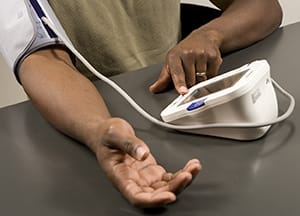
Tips for buying a blood pressure monitor
- The American Heart Association (AHA) recommends an automatic monitor that uses a cuff that goes on your upper arm (bicep).
- The AHA doesn't recommend wrist and finger monitors. Their results are not as reliable as the upper arm monitors.
- Check that the monitor meets the U.S. Blood Pressure Validated Device Listing criteria. See www.validatebp.org for more information.
- Check that the monitor is approved for children, pregnant women, and older adults if it's going to be used for these groups.
- People with smaller or larger arms may need a special cuff size. Measure around the upper arm. Choose a monitor that comes with the correct cuff size.
- Check your monitor's reading with your doctor's reading when the device is new. Check it once a year after that.
- Monitors can wear out over time. They may no longer be able to be adjusted. You may have to replace your monitor if the measurements are very different from the measurements made at your doctor's office.
Author: Ignite Staff
Online Medical Reviewer: Stacey Wojcik MBA BSN RN
Online Medical Reviewer: Steven Kang MD
Date Last Reviewed: 09/01/2025
Copyright Health Ink & Vitality Communications
Need Help? We're Here for You
Our Member and Recipient Services Team is here to help you understand your benefits, find care, or resolve concerns.
800-510-9132
Call NC Quitline
Need support to quit smoking, vaping, or to quit other nicotine products? You can receive support including medicines free of charge:
800-784-8669
Schedule Transportation
Need transportation to a doctor's office, pharmacy, or other covered healthcare service? Contact us to arrange your ride.
800-510-9132
Provider Directory
Need to find a provider like a Primary Care Physician, Specialist, OB/GYN, or a Psychiatrist?
Provider DirectoryRelated Articles
Stress Myocardial Perfusion Scan
Myocardial perfusion is an imaging test. It's also called a nuclear stress test. It's done to show how well blood flows through the heart muscle. It also shows how well the heart muscle is pumping.
Electrocardiogram (ECG)
The ECG is a test that records electrical signals from your heart. The pattern of these signals can tell the healthcare provider if your heart is normal, under stress, or having electrical problems, strain, or damage.
Fluoroscopy Procedure
Fluoroscopy is a type of imaging tool. It looks at moving body structures. It’s much like an X-ray "movie."
Cardiopulmonary Exercise Test (CPET)
This test tells how much air moves in and out of your lungs when you exercise. During the test, you may be asked to walk on a treadmill or ride on a stationary bike. Read on to learn what to expect before, during, and after the test.


