Allergies can cause nasal passages to swell. This narrows the air passages. Allergies also cause increased mucus production in the nose. These changes result in nasal allergy symptoms. Common symptoms include itching, sneezing, stuffy nose, and runny nose. Nasal allergies can also cause problems in other parts of the respiratory system. Some of the more common problems are discussed below. If you think you have any of these problems, talk with your doctor about treatment choices.
Sinus infections
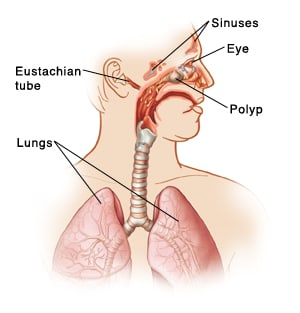
Fluid may be trapped in the sinuses. Bacteria may grow in trapped fluid. This causes sinus infection (sinusitis) and pain. Sometimes the sinus pain can spread to the jaw and be mistaken for dental problems.
Conjunctivitis
Conjunctivitis is the swelling or inflammation of the conjunctiva. This is the thin layer of tissue that lines the inner surface of the eyelid and covers the white part of the eye. Allergens can irritate your eyes, including the lining of the conjunctiva. This causes eyes to become red, itchy, puffy, and watery. Conjunctivitis caused by allergens is not contagious. But some forms of conjunctivitis caused by viruses and bacteria are highly contagious.
Ear problems
The eustachian tube connects the middle ear to nasal passages. Allergies can block this tube, and make the ears feel plugged. Fluid may also build up, leading to an ear infection (otitis media).
Nasal polyps
Allergies cause nasal passages to swell. Constant swelling can lead to formation of a sac that comes from the sinuses called a polyp. Polyps can grow large enough to block nasal passages. Nasal polyps (unlike other polyps) don't cause cancer. But they can cause mild pain and a decreased sense of smell and taste.
Asthma
Asthma is inflammation and swelling of the air passages in the lungs. The symptoms are wheezing, shortness of breath, coughing, and chest tightness. Allergies, including nasal allergies, are common in people with asthma.
Online Medical Reviewer: Deborah Pedersen MD
Online Medical Reviewer: Jessica Gotwals
Online Medical Reviewer: Marianne Fraser MSN RN
Date Last Reviewed: 03/01/2024
© 2000-2026 The StayWell Company, LLC. All rights reserved. This information is not intended as a substitute for professional medical care. Always follow your healthcare professional's instructions.
Need Help? We're Here for You
Our Member and Recipient Services Team is here to help you understand your benefits, find care, or resolve concerns.
800-510-9132
Call NC Quitline
Need support to quit smoking, vaping, or to quit other nicotine products? You can receive support including medicines free of charge:
800-784-8669
Schedule Transportation
Need transportation to a doctor's office, pharmacy, or other covered healthcare service? Contact us to arrange your ride.
800-510-9132
Provider Directory
Need to find a provider like a Primary Care Physician, Specialist, OB/GYN, or a Psychiatrist?
Provider DirectoryRelated Articles
First Aid: Allergic Reactions
Learn how to help when someone is having a limited or severe allergic reaction.
Understanding Hives (Urticaria)
Hives are red, itchy, and swollen areas on the skin. They are most often an allergic reaction from a food, medicine, or insect sting or bite. Read on to learn more about them.
Allergy Overview
Allergies are problems of the immune system. Normally the immune system attacks harmful things such as viruses or bacteria. But sometimes it overreacts and responds to things that are normally harmless. These may include dust, mold, pollen, or food.
Discharge Instructions: Using an Autoinjector
Using an autoinjector makes it easy to give yourself a shot. It also makes it easy for someone else to give you a shot if you can't.