The nervous system is made up of the brain, spinal cord, and nerves. These parts work together to allow your child to think, learn, speak, and feel emotions. They also help to control basic body functions, such as movement, sensation, breathing, and heartbeat. The brain and spinal cord make up the central nervous system. The nerves outside the brain and spinal cord make up the peripheral nervous system.
From the moment a baby is conceived until they are an adult in their mid 20s, the brain grows and develops. Genes affect brain development along with life experiences. The ongoing changes of the brain shape personality, thoughts, and a person’s interaction with the world.
Following is more information about the main parts of the nervous system.
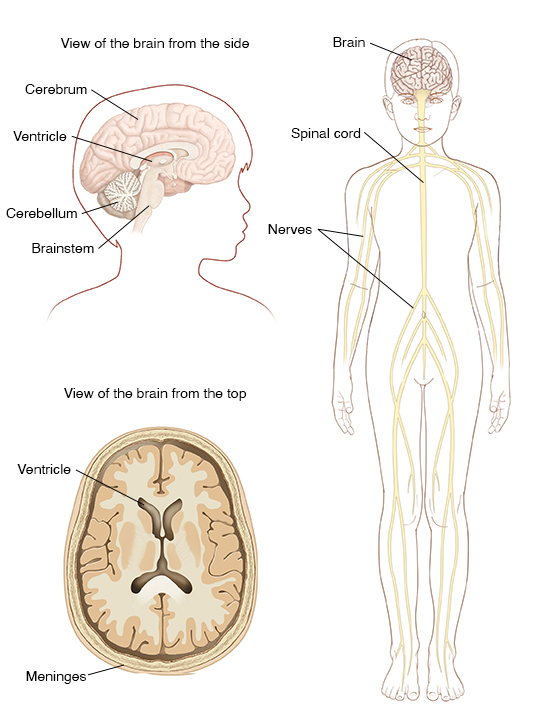
The nervous system
-
The brain is the body’s control center. It tells the body what to do and processes information by sending and receiving messages through the spinal cord and nerves. Each part of the brain has a role:
-
The cerebrum is the largest part of the brain. It's divided into two halves. Each half contains parts (lobes) that control specific functions, such as moving, thinking, or retrieving and storing memories. The cerebrum also receives and processes information from the sensory organs. These organs include the eyes, ears, nose, mouth, and skin.
-
The cerebellum is located under the cerebrum. It helps to control balance and coordinate movement.
-
The brainstem is located at the base of the brain. It controls basic body functions, such as swallowing, breathing, blood pressure, and heart rate. Also, it contains nerves that connect directly to the brain. These nerves are called cranial nerves. They help carry messages to and from the brain to the sensory organs, certain glands, and internal organs, such as the heart and lungs.
-
-
The spinal cord begins at the bottom of the brainstem and runs through the center of the spine (spinal canal). It contains nerves that carry messages to and from the brain to the rest of the body. These nerves are called spinal nerves.
-
Peripheral nerves carry messages to and from the brain and spinal cord to the rest of the body.
-
The heart and digestive system have their own nervous system.
More about the brain
The brain is protected by bone, the meninges, and cerebrospinal fluid.
-
The bone around the brain makes up the skull.
-
The meninges are the layers of tissue that separate the brain from the skull.
-
Cerebrospinal fluid (CSF) is a fluid that cushions the brain within the skull. CSF is made in the ventricles. The ventricles are hollow spaces (cavities) inside the brain. Normally, CSF flows through and around the brain and around the spinal cord.
Featured in
Online Medical Reviewer: Daphne Pierce-Smith RN MSN
Online Medical Reviewer: Marianne Fraser MSN RN
Date Last Reviewed: 04/01/2025
© 2000-2026 The StayWell Company, LLC. All rights reserved. This information is not intended as a substitute for professional medical care. Always follow your healthcare professional's instructions.
Need Help? We're Here for You
Our Member Services team is here to help you understand your benefits, find care, or resolve concerns.
1-800-510-9132
Call NC Quitline
Need support to quit smoking, vaping, or to quit other nicotine products? You can receive support including medicines free of charge:
1-800-784-8669
Schedule Transportation
Need transportation to a doctor's office, pharmacy, or other covered healthcare service? Contact us to arrange your ride.
1-800-510-9132
Provider Directory
Need to find a provider like a Primary Care Physician, Specialist, OB/GYN, or a Psychiatrist?
Provider DirectoryRelated Articles
Discharge Instructions for Epilepsy (Child)
Your child has been diagnosed with epilepsy, a disorder characterized by recurrent, unprovoked seizures, which are brief electrical disturbances in the brain. There are different kinds of seizures, and each child’s seizures are unique. Here's what you need to know about home care.
Spinal Muscular Atrophy in Children
Spinal muscular atrophy (SMA) is a disease of the nerves and muscles caused by certain genes. It causes muscle wasting and weakness.
When Your Child Has a Brain Tumor
If your child has a brain tumor, it can help to know what to expect. This sheet can help.
Brain Abscess in Children
An abscess is a pocket of infection. In the brain, an abscess may be in one or more areas. This condition may cause problems with how the brain and spinal cord function. It is a serious and life-threatening condition that needs to be treated right away.