Exercise is a vital part of maintaining balance, flexibility, and mobility in those with Parkinson disease. Exercise can also help you continue with the activities of daily living. Generally, a mix of 4 types of exercises may be used:
-
Aerobic activity
-
Strength training
-
Balance
-
Flexibility
Your healthcare provider or physical therapist will work with you to develop an exercise program that is right for you, based on your symptoms and challenges. Some common exercises illustrated below may be a good place to start.
How often should I exercise
Do the exercises once a day at first, then build up to several times a day. Being consistent is important. Exercise slowly, and stop if you feel pain. Studies have shown that those exercising earlier in their disease course for at least 2.5 hours per week have a better quality of life.
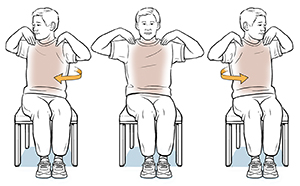
Body twist
Follow these steps:
-
Sit in a chair, facing forward. Place your hands on your shoulders.
-
Turn your head and body to the side as far as possible, as if you were trying to look behind you.
-
Return to starting position, then turn to the other side.
-
Repeat 10 times.
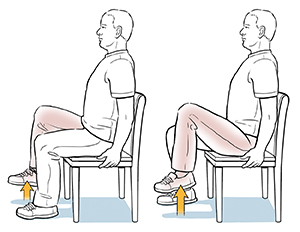
Seated march
Follow these steps:
-
Sit in a chair, facing forward.
-
Slowly lift one knee as high as you can, then lower your foot to the floor.
-
Do the same with your other leg.
-
Repeat 10 times with each leg.
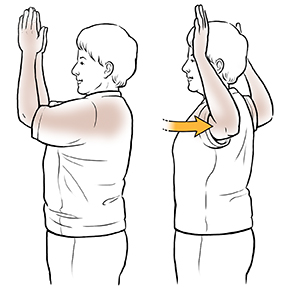
Back stretch
Follow these steps:
-
Stand or sit with your back straight.
-
Hold your arms in front of you. Put your hands and elbows together, hands pointing toward the ceiling.
-
Move your arms apart as far as possible, pushing your shoulder blades together.
-
Slowly move your hands back together.
-
Repeat 10 times.
Online Medical Reviewer: Anne Fetterman RN BSN
Online Medical Reviewer: Marianne Fraser MSN RN
Online Medical Reviewer: Rita Sather RN
Date Last Reviewed: 04/01/2024
© 2000-2026 The StayWell Company, LLC. All rights reserved. This information is not intended as a substitute for professional medical care. Always follow your healthcare professional's instructions.
Need Help? We're Here for You
Our Member and Recipient Services Team is here to help you understand your benefits, find care, or resolve concerns.
800-510-9132
Call NC Quitline
Need support to quit smoking, vaping, or to quit other nicotine products? You can receive support including medicines free of charge:
800-784-8669
Schedule Transportation
Need transportation to a doctor's office, pharmacy, or other covered healthcare service? Contact us to arrange your ride.
800-510-9132
Provider Directory
Need to find a provider like a Primary Care Physician, Specialist, OB/GYN, or a Psychiatrist?
Provider DirectoryRelated Articles
Alzheimer's Dementia and Caregiver Support
Read on for tips about caring for a person with dementia--and getting caregiver support for yourself as well.
How Seizures Affect the Body
The brain is your body's control center. It manages everything from movement and balance to emotions and memory. When a seizure happens, some or all brain functions are temporarily affected.
Partial Seizures: Staying Healthy
With a little bit of planning, most people with partial seizures are able to lead active, fulfilling lives. You can, too. These tips can help you stay as healthy as possible and head off seizures before they happen.
Spinal Cord Injury (SCI): Adjusting After Discharge
Transitioning back into your daily life after a spinal cord injury can be challenging. These tips can help.


