Pain messages travel over nerve pathways to the spinal cord, inside the spine. The spinal cord carries the messages to the brain. Constant pain messages can cause long-term pain that's hard to treat. This is called chronic pain. Spinal cord stimulation is a treatment for chronic pain. It uses a medical device to send mild electrical currents to disrupt the pain messages traveling from your spine to your brain. These currents help block the pain.
Keeping a pain log
Your health care provider may ask you to keep a pain log for a certain amount of time. You may answer questions in your log, such as:
-
When do you feel pain?
-
What does the pain feel like?
-
How long does the pain last?
-
What makes the pain better or worse?
-
When the stimulation is on, is your pain relieved?
Your answers help show how well spinal cord stimulation may work for you. Your provider will give you guidelines for your pain log. You may have to stop taking pain medicine while you are keeping your log. This is to find out how well the stimulation worked on its own. Discuss this with your provider.
Spinal cord stimulation may help
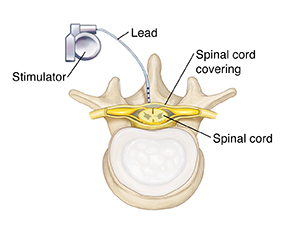
Spinal cord stimulation is 1 type of treatment for chronic pain. Certain criteria need to be met to be a good candidate for this treatment. Spinal cord stimulation uses a small medical device that sends signals to your spinal cord. These signals block the chronic pain messages from being sent to your brain. You may or may not feel mild tingling from the electrical signals. It depends on the device and settings. First, a trial device is worn outside your body. This is to see whether it works to reduce your pain. If your pain is reduced, a permanent device may be used. This device can be removed at any time.
The stimulator system
The stimulator system has several parts. A power source makes the electrical signals. Your health care provider places permanent wires in your spine. And they implant a pulse generator pack into the lower back or upper buttocks area. This is done by a small incision (cut). A small handheld remote controls the stimulator. It can be used to make adjustments as needed. Your provider will explain the system you will be using in more detail.
Risks and possible complications
-
Infection
-
Bleeding
-
Nerve damage
-
Spinal cord damage
-
Failure to relieve pain
Online Medical Reviewer: Marianne Fraser MSN RN
Online Medical Reviewer: Michelle Johnson BSN RN AMB-BC
Online Medical Reviewer: Rita Sather RN
Date Last Reviewed: 03/01/2025
© 2000-2026 The StayWell Company, LLC. All rights reserved. This information is not intended as a substitute for professional medical care. Always follow your healthcare professional's instructions.
Need Help? We're Here for You
Our Member and Recipient Services Team is here to help you understand your benefits, find care, or resolve concerns.
800-510-9132
Call NC Quitline
Need support to quit smoking, vaping, or to quit other nicotine products? You can receive support including medicines free of charge:
800-784-8669
Schedule Transportation
Need transportation to a doctor's office, pharmacy, or other covered healthcare service? Contact us to arrange your ride.
800-510-9132
Provider Directory
Need to find a provider like a Primary Care Physician, Specialist, OB/GYN, or a Psychiatrist?
Provider DirectoryRelated Articles
Focal Seizures (Partial Seizures): Know What to Do
Because seizures may happen at any time, it helps to be prepared. This is true even if medicine usually keeps your seizures under control. Start by telling those you live and work with about your health condition. Make sure they know what to do if a seizure happens
Vagus Nerve Stimulator
A vagus nerve stimulator (VNS) is a device that can help prevent seizures.
Understanding a Burr Hole Procedure
Burr holes are small holes that a neurosurgeon makes in the skull. Burr holes are used to help relieve pressure on the brain when fluid, such as blood, builds up and starts to press on brain tissue. Read this to understand why and how they are done and what the risks are.
First Aid: Head Injuries
A strong blow to the head may cause swelling and bleeding inside the skull. The resulting pressure can injure the brain (concussion).


