A brain abscess is a local infection in the brain caused by bacteria or fungus. In response to the infection, the body forms a sac around the affected area. A brain abscess can press on the brain, damage tissue, or block blood vessels in the brain. It's a serious and life-threatening condition that must be treated right away. With treatment, some children can recover with few or no complications.
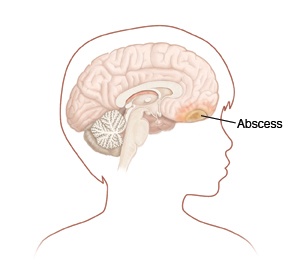
What are the causes of a brain abscess?
Your child may have developed a brain abscess in one of the following ways:
-
Bacteria or fungus may have traveled through the bloodstream to the brain from another area of infection in the body.
-
Bacteria or fungus may have entered the brain directly through a wound such as a head injury, ear or dental infection, or surgery.
What are the symptoms of a brain abscess?
Symptoms of a brain abscess can come on slowly or suddenly. They can include:
-
Fever.
-
Headache.
-
Stiff neck.
-
Nausea or vomiting.
-
Seizures or convulsions.
-
Trouble with vision and sensitivity to light.
-
Trouble with speech, balance, or movement.
-
Problems staying awake and alert.
How is a brain abscess diagnosed?
A brain abscess often causes severe and sudden symptoms that should be seen in an emergency room. Your child will likely see a pediatric neurologist or a neurosurgeon for diagnosis and treatment. This is a doctor who specializes in neurologic problems in children. The doctor examines your child. They also ask about your child’s health history and symptoms. Your child may also need to see a specialist in infectious disease. The following may then be done:
-
An exam to check how well your child’s nervous system is working. The doctor checks your child’s muscle strength, balance, coordination, and reflexes. They may also check skills such as thinking, memory, vision, hearing, and talking.
-
MRI or CT scan to provide pictures of the brain. These help the doctor find the abscess and see how large it is. Contrast dye may be used to make the abscess easier to see. Medicine can be given to help your child stay calm and lie still during the tests.
-
A CT-guided aspiration of the abscess. A sample is sent to a lab for culture to find out what organism is causing the infection. The culture results help the doctor find the right antibiotic treatment.
How is a brain abscess treated?
-
Hospital care is needed right away for a brain abscess. Your child is carefully watched until symptoms improve.
-
Treatment consists of medicines given by an IV (intravenous) line. In severe cases, the medicines are given directly into the brain. Medicines can include antibiotics, antifungal medicines, steroids, and medicines to decrease the pressure in your child's brain due to the abscess. Antibiotics treat a possible infection. This depends on your child's health history and other health problems. Antibiotics will be started before the result of the culture is known. One that covers the most common bacterial infections will likely be started first. Antibiotic treatment may change after the test result comes back.
-
Your child’s doctor will speak with you about other treatments, such as surgery, if they are needed. Usually, large abscesses (more than 2 cm) are removed with a needle (aspirated) or surgery.
-
Treatment time varies. In some cases, treatment can be completed at home.
What are the long-term concerns?
After treatment, many children recover completely. Some children will have ongoing nervous system problems such as trouble with speech or movement. Some may have seizures. Regular follow-up with the doctor may be recommended depending on your child’s condition. Supportive care, such as speech, physical, or occupational therapy, may be prescribed to help your child recover.
Featured in
Online Medical Reviewer: Amy Finke RN BSN
Online Medical Reviewer: Joseph Campellone MD
Online Medical Reviewer: Raymond Kent Turley BSN MSN RN
Date Last Reviewed: 10/01/2024
© 2000-2026 The StayWell Company, LLC. All rights reserved. This information is not intended as a substitute for professional medical care. Always follow your healthcare professional's instructions.
Need Help? We're Here for You
Our Member Services team is here to help you understand your benefits, find care, or resolve concerns.
1-800-510-9132
Call NC Quitline
Need support to quit smoking, vaping, or to quit other nicotine products? You can receive support including medicines free of charge:
1-800-784-8669
Schedule Transportation
Need transportation to a doctor's office, pharmacy, or other covered healthcare service? Contact us to arrange your ride.
1-800-510-9132
Provider Directory
Need to find a provider like a Primary Care Physician, Specialist, OB/GYN, or a Psychiatrist?
Provider DirectoryRelated Articles
When Your Child Has Encephalitis
Encephalitis is inflammation of the brain. It's often caused by a virus. Learn about the symptoms, and how it's diagnosed and treated.
When Your Child Has Intracranial Hemorrhage
Intracranial hemorrhage is bleeding in the brain. This can damage brain tissue. Treatment can help reduce the chance of long-term brain problems.
When Your Child Has a Brain Tumor
If your child has a brain tumor, it can help to know what to expect. This sheet can help.
Head Injury in Children
A head injury can be as mild as a bump, bruise (contusion), or cut on the head. Or it can be a concussion, a deep cut or open wound, broken skull bones, internal bleeding, or damage to the brain. Head injuries are one of the most common causes of disability and death in children.


