A foraminotomy is a surgery to widen an area in one of your spinal bones (vertebrae). This takes pressure off a nerve that is compressed by the surrounding bone.
About your spine
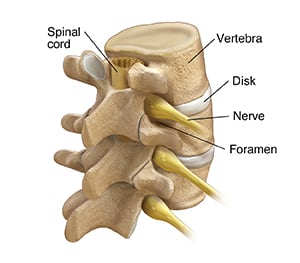
Your backbone, or spinal column, is made up of a chain of bones called the vertebrae. Your spinal cord runs through the spinal column. The bones help protect the spinal cord from injury. Discs sit between each vertebra to provide cushioning and support. Large nerves called nerve roots exit the spinal cord through small holes between the bones called foramen. These nerve roots send and receive signals to and from the body. The signals are sent to and from your brain through the spinal cord.
In some people, the foramen can become too small. This is called foraminal stenosis, or spinal stenosis. This puts pressure on the nerve roots. The pressure can cause symptoms like pain, tingling of your arms or legs, and weakness. Your symptoms will vary depending on which nerve is compressed. For example, a compressed nerve in your neck may lead to neck pain and tingling and weakness in your hand and arm. A compressed nerve in your lower back may cause lower back and leg pain or tingling.
Why a foraminotomy is done
A number of things can block your foramen and squeeze a nerve root leaving your spinal cord. Problems that can cause spinal stenosis include:
- Degenerative arthritis of your spine (spondylosis) that can cause bony spurs.
- Degeneration of the discs that cause them to bulge into the foramen.
- Enlargement of the nearby ligament.
- A vertebra moving out of place (spondylolisthesis).
- Cysts or tumors.
- Skeletal disease, such as Paget disease.
- Congenital problems, such as dwarfism.
You may need a foraminotomy if other treatments have not worked, such as physical therapy, pain medicine, or epidural injections. In some cases, an emergency foraminotomy may need to be done. This may be the case if your symptoms get worse quickly or if you lose bladder control because of the compressed nerve.
How a foraminotomy is done
The surgery is done by a neurosurgeon or orthopedic surgeon. The surgery can be done in several ways. During the procedure, you will lie on your stomach. The surgeon will make small cuts in the skin just beside your spine, near your symptoms. They will use small tools to remove the blockage inside the foramen. This may be a bone spur or a bulging disc. This will relieve pressure on the nerve root.
Risks of foraminotomy
Every surgery has risks. Risks for this surgery include:
- Infection.
- Too much blood loss.
- Nerve damage.
- Damage to your spinal cord.
- Stroke.
- Problems from anesthesia.
- Your symptoms don't go away.
The risk for problems can vary depending on certain reasons. These include your age, your general health, which vertebra is affected, the size and shape of your foramen, and how the surgery is done. Ask your doctor about the risks that most apply to you.
Online Medical Reviewer: Anne Fetterman RN BSN
Online Medical Reviewer: Luc Jasmin MD
Online Medical Reviewer: Raymond Kent Turley BSN MSN RN
Date Last Reviewed: 09/01/2025
© 2000-2026 The StayWell Company, LLC. All rights reserved. This information is not intended as a substitute for professional medical care. Always follow your healthcare professional's instructions.
Need Help? We're Here for You
Our Member and Recipient Services Team is here to help you understand your benefits, find care, or resolve concerns.
800-510-9132
Call NC Quitline
Need support to quit smoking, vaping, or to quit other nicotine products? You can receive support including medicines free of charge:
800-784-8669
Schedule Transportation
Need transportation to a doctor's office, pharmacy, or other covered healthcare service? Contact us to arrange your ride.
800-510-9132
Provider Directory
Need to find a provider like a Primary Care Physician, Specialist, OB/GYN, or a Psychiatrist?
Provider DirectoryRelated Articles
Deep Brain Stimulation (DBS)
Deep brain stimulation (DBS) is a type of therapy that uses electrical stimulation to treat neurological conditions, such as Parkinson disease (PD), tremors, and dystonia. It can ease symptoms and decrease the amount of medicines you need, and improve your quality of life.
Lumbar Disc Replacement
A lumbar disc replacement involves replacing a worn or degenerated disc in the lower part of the spine with an artificial replacement made of metal or a combination of metal and plastic.
The Day of Your Craniotomy
Learn what to expect the day of your surgery.
AVM: Preparing for surgery
Here you will find out how to prepare for AVM surgery, what to expect the day of surgery, and the risks of surgery.


