The spine has 3 natural curves. The cervical curve is in the neck. It forms the top part of the spine. This part is also known as the cervical spine. This sheet tells you more about the parts of the cervical spine and damaged disks. This is a common problem that can affect the cervical spine. Most people don't need surgery for this.
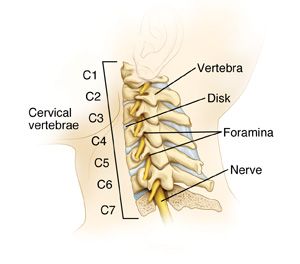
A healthy cervical spine
The spine is made up of these parts:
-
Vertebrae. These are bones stacked like building blocks that make up the spine. The neck contains the first 7 vertebrae of the spine.
-
Disks. These are small pads of tissue that lie between the vertebrae. They help cushion and protect the vertebrae and allow your spine to move.
-
The spinal cord. This nerve tissue runs through a large central opening (spinal canal) formed by the vertebrae.
-
Nerve root. These branch out from the spinal cord and carry signals to the body.
-
Foramina. These are smaller openings on each side of the vertebrae. Nerve roots and the nerves they form lead to your neck, shoulders, arms, and hands from the spinal cord through these openings.
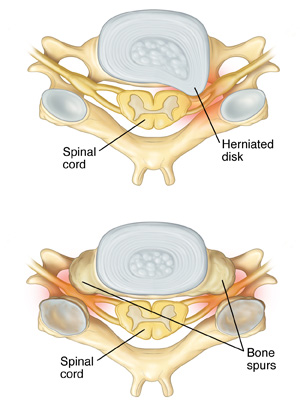
Damaged disks in the cervical spine
A common cervical spine problem is a damaged disk. A disk may be injured by a sudden movement. This can cause a disk to bulge or break open (herniate). Or a disk may wear out slowly over time (degenerate). A worn-out disk may become very flat. Then the vertebrae above and below it touch or slip back and forth. As disks wear out, abnormal bone growths (bone spurs) can form on the vertebrae. Bone spurs can also form in the foramina. This causes them to narrow (stenosis) and press on the nerve root.
If your healthcare provider thinks that you have a damaged disk, you may have tests to confirm the problem. You may have any of these:
-
MRI
-
CT scan
-
Flexion-extension X-ray films
-
Electromyography (EMG)
-
Nerve conduction studies
Your healthcare provider will then work with you to plan treatment as needed.
Online Medical Reviewer: Anne Fetterman RN BSN
Online Medical Reviewer: Luc Jasmin MD
Online Medical Reviewer: Raymond Kent Turley BSN MSN RN
Date Last Reviewed: 09/01/2024
© 2000-2026 The StayWell Company, LLC. All rights reserved. This information is not intended as a substitute for professional medical care. Always follow your healthcare professional's instructions.
Need Help? We're Here for You
Our Member and Recipient Services Team is here to help you understand your benefits, find care, or resolve concerns.
800-510-9132
Call NC Quitline
Need support to quit smoking, vaping, or to quit other nicotine products? You can receive support including medicines free of charge:
800-784-8669
Schedule Transportation
Need transportation to a doctor's office, pharmacy, or other covered healthcare service? Contact us to arrange your ride.
800-510-9132
Provider Directory
Need to find a provider like a Primary Care Physician, Specialist, OB/GYN, or a Psychiatrist?
Provider DirectoryRelated Articles
Head Trauma (Traumatic Brain Injury)
Head trauma can be fatal. The effects from some types of head trauma may not appear right away. So it’s important to get medical attention for any severe head injury.
Cranial Neuropathies
Cranial neuropathy is a disorder that causes nerve damage in the nerves that arise from the brain and brainstem. This disorder can affect the ability of the face and eyes to feel and move.
Dermoid Cyst of the Brain or Spinal Cord
A dermoid cyst is the growth of normal tissue in an abnormal place in the body. The cyst is benign (not cancer). It contains different types of tissue, such as hair follicles, cartilage, sweat glands, and glands that make skin oils. A dermoid cyst in the brain or spinal cord is a rare type of dermoid cyst. They often appear in children under age 10, but can also appear in older children and young adults.
Encephalitis
Encephalitis is a viral infection of the brain. It may cause headache, stiff neck, irritability, fever, drowsiness, nausea and vomiting.


