It's never too early for good dental care. With good oral health care, your child can grow up cavity-free. Start by caring for your baby's gums and teeth. As they grow, teach your child the best possible tooth care. Don't forget that healthy teeth and gums need regular visits to the dentist.
Brushing
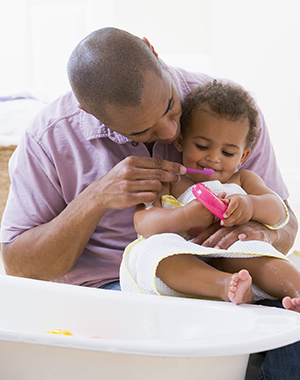
Food and bacteria form a sticky substance called plaque on teeth. Bacteria in the plaque make acid that eats away at the tooth's hard coating (the enamel). The enamel becomes porous as tiny holes appear, allowing bacteria to enter. This causes tooth decay. Brushing stops plaque from building up. Begin cleaning your baby's gums a few days after birth. At first, use water and a piece of cotton gauze. As teeth come in, use a small toothbrush and a tiny grain-sized or rice-sized amount of fluoride toothpaste. Only use a tiny amount because children tend to swallow the toothpaste. A training toothpaste (nonfluoridated) can also be used at this stage. Talk with your dentist or healthcare provider for advice on using a fluoride supplement, such as drops or tablets. When your child is old enough to brush on their own, watch to be sure it's done right.
Flossing
Flossing removes bacteria and plaque from between the teeth and under the gums. Floss your child's teeth daily. When the child is old enough, a floss holder can help them floss.
Fluoride
Fluoride makes tooth enamel stronger. This helps prevent cavities. Find out if your community's water has fluoride added to it. If not, ask your dentist if your child should be given fluoride supplements. Your dentist may also apply fluoride to your child's adult teeth at regular checkups.
Sealants
Sealants are a safe, painless, and low-cost way to help protect your child's back teeth from decay. A thin plastic coating is bonded to the chewing surfaces of the molars and premolars. The sealant forms a hard shield that keeps food and bacteria from getting into the tiny grooves on the surface of the teeth.
When to call the dentist
Keep an eye on the following:
-
Tooth decay. Never let your child sleep with a bottle. Bottle liquids (even milk) that sit in the mouth can quickly cause tooth decay. Don't let your child drink or snack without brushing afterward.
-
Thumb sucking and pacifiers. Sucking on a thumb or pacifier is common for a baby. But if either habit continues past age 3 or 4, it may lead to tooth or jaw problems. If using a pacifier, an orthopedic pacifier is best for the teeth and jaws.
Call the dentist for any of the following:
-
Starting around age 1, your child should have regular dental checkups every 6 months.
-
Talk with your dentist if baby or adult teeth are crooked or fail to come in.
-
Call the dentist if you see brown or black spots on your child's teeth.
-
If a tooth is knocked out, get emergency dental care. Don't wash the tooth. Put it in milk until it can be put back in place.
Featured in
Online Medical Reviewer: Dan Brennan MD
Online Medical Reviewer: Jessica Gotwals RN BSN MPH
Online Medical Reviewer: Michael Kapner MD
Date Last Reviewed: 02/01/2025
© 2000-2026 The StayWell Company, LLC. All rights reserved. This information is not intended as a substitute for professional medical care. Always follow your healthcare professional's instructions.
Need Help? We're Here for You
Our Member and Recipient Services Team is here to help you understand your benefits, find care, or resolve concerns.
800-510-9132
Call NC Quitline
Need support to quit smoking, vaping, or to quit other nicotine products? You can receive support including medicines free of charge:
800-784-8669
Schedule Transportation
Need transportation to a doctor's office, pharmacy, or other covered healthcare service? Contact us to arrange your ride.
800-510-9132
Provider Directory
Need to find a provider like a Primary Care Physician, Specialist, OB/GYN, or a Psychiatrist?
Provider DirectoryRelated Articles
Night Terrors
Watching your child have a night terror can be very upsetting. These tips can help you know what to expect and when your child might need to see a health care provider.
Selective Mutism
Selective mutism is a rare condition in which a child can’t speak in certain settings but can speak fine in others. It can cause problems with school and social situations.
Flushing Your Child’s PICC Line at Home
Your child's PICC line is an important part of their health care. To care for your child's PICC line, you'll need to flush it. Here are instructions on what to do.
School Refusal
There are many reasons why a child would feel anxious and not want to go to school. Read on to learn more about school refusal.