Plaque is a sticky coating of bacteria and other substances that forms on your teeth and gums. It can cause two serious problems: tooth decay and gum disease. These problems damage the teeth and gums. They may even lead to tooth loss. When the mouth is well cared for, tooth decay and gum disease can be reversed in their early stages. Better yet, you can prevent these problems from starting by:
-
Brushing at least twice a day and flossing daily.
-
Maintaining a healthy diet.
-
Not snacking between meals on foods high in sugar and starch.
How tooth decay occurs
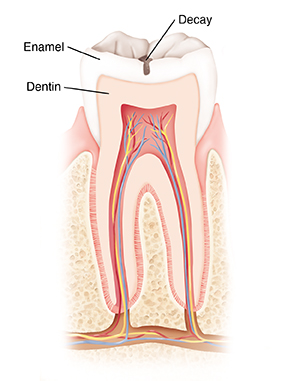
Tooth decay happens when bacteria in plaque make acids that eat away at the tooth. Cavities (also called caries) are holes that form in the teeth. They are most common in places that are hard to reach with a toothbrush. This includes the grooves at the tops of the back teeth, and on the sides where the teeth touch. In late stages, tooth decay can be painful. It can also lead to tooth loss.
Treating tooth decay
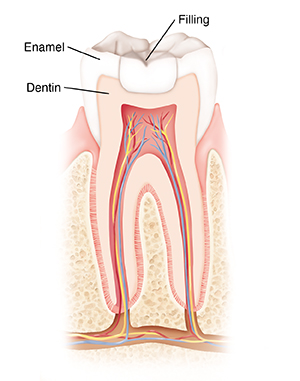
Tooth decay can be treated to keep it from moving farther into the tooth. This is often done by filling cavities. First any tooth decay is removed. This protects the tooth from more damage. Then the cavity is filled with a hard material. This filling protects the damaged tooth and restores the tooth's surface. If the tooth is severely damaged by decay, other treatments are available.
Follow-up visits
Visit your dental team at least every
Online Medical Reviewer: Jessica Gotwals RN BSN MPH
Online Medical Reviewer: Michael Kapner MD
Online Medical Reviewer: Tennille Dozier RN BSN RDMS
Date Last Reviewed: 04/01/2025
© 2000-2026 The StayWell Company, LLC. All rights reserved. This information is not intended as a substitute for professional medical care. Always follow your healthcare professional's instructions.
Need Help? We're Here for You
Our Member and Recipient Services Team is here to help you understand your benefits, find care, or resolve concerns.
800-510-9132
Call NC Quitline
Need support to quit smoking, vaping, or to quit other nicotine products? You can receive support including medicines free of charge:
800-784-8669
Schedule Transportation
Need transportation to a doctor's office, pharmacy, or other covered healthcare service? Contact us to arrange your ride.
800-510-9132
Provider Directory
Need to find a provider like a Primary Care Physician, Specialist, OB/GYN, or a Psychiatrist?
Provider DirectoryRelated Articles
What Are Sensitive Teeth?
Read on to learn about sensitive teeth.
Stages of Periodontal Disease
Periodontal disease is an infection of the gums and tissues supporting the teeth. If not treated, it often gets worse. Bone damage and tooth loss can occur. Regular self-care and dental visits can help prevent or control periodontal disease.
Dental Implants: The Right Prosthesis for You
If you have one or more missing teeth, your dentist may recommend dental implants. A dental implant is an artificial tooth root. Your jawbone fuses with the implant to provide a secure platform for a prosthesis (artificial tooth).
Dental Cavity
A dental cavity is a pit or crater in the surface of a tooth. Learn how to care for a cavity and when to get medical treatment.


