Food gives the body the energy needed for life. The digestive system breaks food down into basic nutrients that can be used by the body. The digestive tract is a long, muscular tube that extends from the mouth through the stomach and intestines to the anus. As food moves along the digestive tract, it's digested. This means it's changed into substances that can be absorbed into the bloodstream. Certain organs (such as the liver, gallbladder, and pancreas) help with this digestion. Parts of food that can't be digested are turned into stool. This is waste material that's passed out of the body.
Digestive system
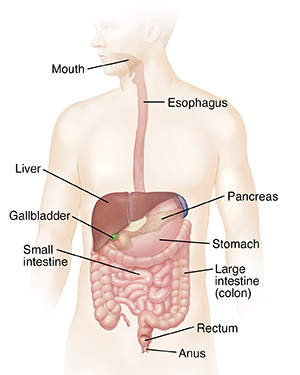
The digestive system is made up of the following:
-
The mouth. Takes in food, breaks it into pieces, and begins the digestion process.
-
The esophagus. Moves food from the mouth to the stomach.
-
Thestomach. Breaks food down into a liquid mixture.
-
Theliver. Makes bile that helps digest fat, removes toxins from blood, and maintains healthy blood sugar levels.
-
The gallbladder. Stores, concentrates, and controls the flow of bile into the small intestine.
-
Thepancreas. Makes enzymes that help in digestion. And makes hormones that help control blood sugar.
-
Thesmall intestine. Digests food further. And absorbs nutrients and water from food so they can be used by the body. What's left is passed on to the colon as liquid waste.
-
The large intestine (colon). Absorbs water, salt, and minerals from the waste, forming a solid stool.
-
The rectum. Stores stool until a bowel movement happens.
-
Theanus. The opening where stool leaves the body.
Online Medical Reviewer: Jen Lehrer MD
Online Medical Reviewer: Raymond Kent Turley BSN MSN RN
Online Medical Reviewer: Rita Sather RN
Date Last Reviewed: 08/01/2023
© 2000-2026 The StayWell Company, LLC. All rights reserved. This information is not intended as a substitute for professional medical care. Always follow your healthcare professional's instructions.
Need Help? We're Here for You
Our Member and Recipient Services Team is here to help you understand your benefits, find care, or resolve concerns.
800-510-9132
Call NC Quitline
Need support to quit smoking, vaping, or to quit other nicotine products? You can receive support including medicines free of charge:
800-784-8669
Schedule Transportation
Need transportation to a doctor's office, pharmacy, or other covered healthcare service? Contact us to arrange your ride.
800-510-9132
Provider Directory
Need to find a provider like a Primary Care Physician, Specialist, OB/GYN, or a Psychiatrist?
Provider DirectoryRelated Articles
The Biliary System: Anatomy and Functions
Detailed anatomical description of the biliary system, including a full-color labeled illustration.
How the Colon Works
Read on to learn more about the colon, including some helpful diagrams.
The Digestive Process: What Does the Small Intestine Do?
At 20 feet long, your small intestine is the longest part of the human digestive system. Most of the digestive process takes place there.
The Digestive Process: Digestion Begins in the Mouth
Digestion is a multistep process that begins the moment you place a piece of food in your mouth or sip some juice.


