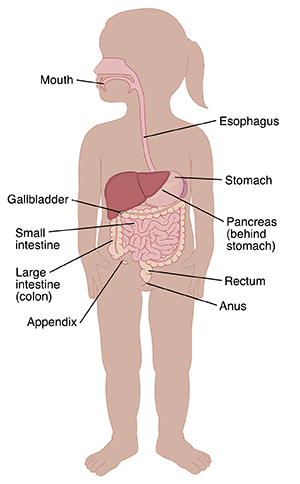
The digestive system breaks food down into basic nutrients that can be used by the body. As food moves through the digestive tract, it’s digested (broken down into parts and absorbed into the bloodstream). Certain organs, such as the liver, gallbladder, and pancreas, help with this digestion. Parts of food that can’t be digested become stool. This is waste material that’s passed out of the body.
Digestive system
-
The mouth takes in food and breaks it into pieces. It starts the process of digestion.
-
The esophagus moves food from the mouth to the stomach.
-
The stomach breaks food down into a liquid mixture.
-
The small intestine digests food further and absorbs nutrients. What’s left is passed on to the colon as liquid waste.
-
The large intestine (colon) absorbs water, salt, and other minerals from liquid waste, forming a solid stool.
-
The rectum stores stool until a bowel movement occurs.
-
The anus is the opening where stool leaves the body.
-
The liver makes bile (a fluid that helps digest fat). It also breaks down nutrients and stores energy.
-
The gallbladder stores bile.
-
The pancreas makes enzymes that help with digestion.
-
The appendix is a small, hollow structure that’s attached to the large intestine. It has no clear function in the body. But it can become blocked and infected.
Featured in
Online Medical Reviewer: Amy Finke RN BSN
Online Medical Reviewer: L Renee Watson MSN RN
Online Medical Reviewer: Liora C Adler MD
Date Last Reviewed: 12/01/2024
© 2000-2026 The StayWell Company, LLC. All rights reserved. This information is not intended as a substitute for professional medical care. Always follow your healthcare professional's instructions.
Need Help? We're Here for You
Our Member and Recipient Services Team is here to help you understand your benefits, find care, or resolve concerns.
800-510-9132
Call NC Quitline
Need support to quit smoking, vaping, or to quit other nicotine products? You can receive support including medicines free of charge:
800-784-8669
Schedule Transportation
Need transportation to a doctor's office, pharmacy, or other covered healthcare service? Contact us to arrange your ride.
800-510-9132
Provider Directory
Need to find a provider like a Primary Care Physician, Specialist, OB/GYN, or a Psychiatrist?
Provider DirectoryRelated Articles
When Your Child Has Diarrhea
Diarrhea is one of the most common illnesses in children. It can lead to too much fluid loss (dehydration) which can be serious. So preventing dehydration is important in managing your child's diarrhea. Here's what you need to know.
Discharge Instructions for Hypocalcemia (Child)
Hypocalcemia means your child doesn't have enough calcium in their blood. Some changes will need to be made to your child's diet.
When Your Child Has Celiac Disease
Celiac disease is a problem that affects your child's ability to get nutrients from food. It is caused by a sensitivity to gluten. This is a protein found in many grains. Celiac cannot be cured, but it can be managed and the damage reversed.
GERD (Gastroesophageal Reflux Disease) in Children
GERD is sometimes called acid indigestion or heartburn. It happens when stomach contents flow back up (reflux) into the esophagus. If your child has GERD, they should be checked by a health care provider.