A barium enema is an X-ray exam of your rectum and colon. This test helps your doctor find problems, such as blockages, inflammatory bowel disease, or polyps.
Before your test
-
Your doctor will give you detailed instructions on how to get ready for this test.
-
On the day before your test, you will likely be told not to eat and to drink only clear liquids. Don't eat or drink anything after midnight the night before. But you may take your regularly prescribed oral medicine in the morning with a small amount of water.
-
You will also be told to take a laxative or an over-the-counter enema preparation. Follow your doctor's instructions.
Let the technologist know about the following before the test
-
Symptoms you’re having
-
Allergies
-
Any past surgery or recent illness
-
Medicines you take
-
If you're pregnant or think you may be
Risks of the test
-
Radiation exposure
-
Allergic reaction to contrast
-
Gastrointestinal tract obstruction
During your test
-
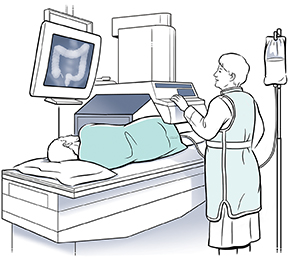
A tube is inserted into your rectum.
-
Your colon is filled with barium. This is a liquid that allows the radiologist to see what the inside of your bowel looks like by using X-ray images. Air is also often placed into your bowel through the tube to allow for better visualization.
-
You will be asked to move into different positions and hold your breath while X-rays are taken.
-
Pressure may be applied to your belly to get the best images.
-
The last X-ray will be taken after you go to the bathroom.
-
The test usually lasts 30 to 60 minutes.
After your test
-
Drink plenty of water to relieve constipation you may have after the test.
-
Your stool may look white or light for 1 to 2 days.
-
Your doctor will discuss the test results with you during a follow-up visit or over the phone.
-
Your next appointment is:
When to contact your doctor
Contact your doctor right away if you have:
-
Belly (abdominal) pain.
-
Blood in your stool.
-
No bowel movement for more than 2 days or are unable to pass gas.
-
Dizziness or weakness.
-
A fever of 100.4°F (38°C) or higher, or as directed by your doctor.
Online Medical Reviewer: Jessica Gotwals RN BSN MPH
Online Medical Reviewer: Neil Grossman MD
Online Medical Reviewer: Raymond Turley Jr PA-C
Date Last Reviewed: 04/01/2025
© 2000-2026 The StayWell Company, LLC. All rights reserved. This information is not intended as a substitute for professional medical care. Always follow your healthcare professional's instructions.
Need Help? We're Here for You
Our Member and Recipient Services Team is here to help you understand your benefits, find care, or resolve concerns.
800-510-9132
Call NC Quitline
Need support to quit smoking, vaping, or to quit other nicotine products? You can receive support including medicines free of charge:
800-784-8669
Schedule Transportation
Need transportation to a doctor's office, pharmacy, or other covered healthcare service? Contact us to arrange your ride.
800-510-9132
Provider Directory
Need to find a provider like a Primary Care Physician, Specialist, OB/GYN, or a Psychiatrist?
Provider DirectoryRelated Articles
Upper GI (Gastrointestinal) Series
An upper GI series is an X-ray exam of the esophagus, stomach, and duodenum. This test helps your doctor find problems, such as difficulty swallowing and certain diseases.
Rectal Prolapse
Rectal prolapse means the rectum has fallen out of position. In many cases, rectal tissue sags out of the anus. Here's what you need to know.
Colostomy: Selecting Your Pouch
After a colostomy, stool is most often collected in a pouch that attaches to your body around the stoma. An adhesive skin barrier holds the pouch in place and keeps stool from leaking onto the skin. Most pouches are made of lightweight, odor-proof plastic. They lie flat against the body so they don't show or make noise.
Feeding Tube Insertion
Learn how to care for yourself at home after you've had a feeding tube inserted.


