ERCP stands for endoscopic retrograde cholangiopancreatography. This procedure is used to view the biliary and pancreatic ducts. It's used to check diseases that affect the biliary and pancreatic ducts. It can also help find and treat any blockages.
How to say it
koh-LAN-jee-oh-pan-kree-uh-TAW-gruh-fee
How do I get ready for ERCP?
- Talk with your doctor about any health problems or allergies you have.
- Ask your doctor about the risks of ERCP. These include:
- Pancreatitis
- Infection
- Bleeding
- Tears in the bowel
- You may be asked to take antibiotics ahead of time.
- Don't take blood-thinning medicines before ERCP, as advised by your doctor.
- Don't eat or drink for 8 to 12 hours before ERCP.
- Have someone ready to take you home.
- Be sure your doctor knows about all medicines you take. You may be told to stop taking some or all of them before the test. This includes:
- All prescription medicines
- Over-the-counter medicines that don't need a prescription
- Any illegal drugs you may use
- Herbs, vitamins, kelp, seaweed, cough syrups, and other supplements
What happens during the procedure?
- You will be given medicine through an I.V. (intravenous line) to help you relax.
- Your throat is numbed.
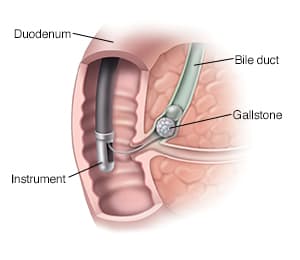
- A thin tube (endoscope) is placed into your throat. It's moved down your throat through the upper digestive tract to the common bile duct opening. The endoscope lets the doctor see the common bile and pancreatic ducts on a video screen.
- A cut may be made where the common bile duct opens to the first part of the small intestine (duodenum). This makes it easier to remove stones.
- As blockages are found and taken out, X-rays are taken.
- Contrast dye is injected through a catheter. This makes the duct show up better on the X-rays.
- An imaging technique called fluoroscopy is done. It uses X-rays to get real-time moving images of internal organs. It's used to watch and guide progress of the ERCP.
- In some cases, a plastic tube (stent) is placed to hold the ducts open. This stent may be replaced or taken out in 6 to 8 weeks. Or it may be left to fall out on its own. It will then pass in the stool.
After the procedure
Your doctor may talk with you about the test results right away. Or you may need to schedule a return visit. Depending on your health problem and the test results, you may go home the same day. Or you may have to spend the night in the hospital. If you are sent home, follow these guidelines:
- Unless told otherwise by your doctor, you can go back to a normal routine the day after the ERCP.
- If a cut was made in the duct, don't take blood-thinning medicines, such as aspirin, for 5 to 7 days, or as advised by your doctor.
- Call your doctor right away if you have a fever or belly pain. These may be signs of an infection or a tear in your bowel.
Online Medical Reviewer: Melinda Murray Ratini DO
Online Medical Reviewer: Neil Grossman MD
Online Medical Reviewer: Tara Novick BSN MSN
Date Last Reviewed: 09/01/2025
© 2000-2026 The StayWell Company, LLC. All rights reserved. This information is not intended as a substitute for professional medical care. Always follow your healthcare professional's instructions.
Need Help? We're Here for You
Our Member and Recipient Services Team is here to help you understand your benefits, find care, or resolve concerns.
800-510-9132
Call NC Quitline
Need support to quit smoking, vaping, or to quit other nicotine products? You can receive support including medicines free of charge:
800-784-8669
Schedule Transportation
Need transportation to a doctor's office, pharmacy, or other covered healthcare service? Contact us to arrange your ride.
800-510-9132
Provider Directory
Need to find a provider like a Primary Care Physician, Specialist, OB/GYN, or a Psychiatrist?
Provider DirectoryRelated Articles
Endoscopic Ultrasound (EUS)
This topic tells what an endoscopic ultrasound (IUS) test is, how it's done, and what to expect from it.
Prep for Upper GI Test
An upper GI test will help you find out if you have a problem in your esophagus, stomach, or intestines that is causing your symptoms. Follow these instructions to prepare for the test.
Diagnosing Hemorrhoids
To diagnose hemorrhoids, your healthcare provider will rule out other problems and determine how bad your hemorrhoids are. Read on to learn more.
Esophageal Manometry
Esophageal manometry is a test to measure the strength and function of the esophagus. Here's what you can expect when having the test.