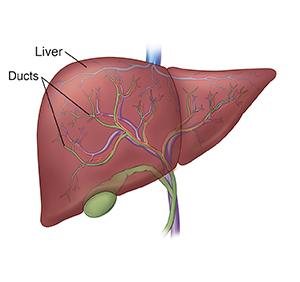
Bile is made in the liver and stored in the gallbladder. It helps digest food. Bile normally passes out of the liver through a series of tubes (ducts). Bile can back up into the liver if a duct becomes blocked. It can also leak into the surrounding tissues if a hole or tear forms in a duct. Biliary drainage is a procedure to drain bile from the liver. The procedure is done by a specially trained healthcare provider called an interventional radiologist.
How do I do get ready for biliary drainage?
You may have been given directions on how to get ready. These include:
-
Follow any directions you’re given for not eating or drinking before the procedure.
-
Tell the technologist if you are or could be pregnant, or if you are breastfeeding.
-
Tell the technologist if you are allergic to X-ray dye (contrast medium) or other medicines.
-
Be sure your healthcare provider knows about all health conditions you have and all medicines you take. You may be told to stop taking some or all of them before the test. This includes:
-
All prescription medicines
-
Over-the-counter medicines that don’t need a prescription
-
Any illegal drugs you may use
-
Herbs, vitamins, kelp, seaweed, cough syrups, and other supplements
-
What happens during biliary drainage?
-
You will change into a hospital gown and lie on an X-ray table.
-
An IV (intravenous) line will be put into a vein in your hand or arm. This is to give you fluids and medicines. You may be given medicine to help you relax and make you feel sleepy.
-
The skin on your upper abdomen is cleaned. Medicine is put in the skin and tissue outside the liver to numb it.
-
A needle is put into the liver. Contrast medium is injected into the liver and bile ducts. This helps the duct system show up clearly on X-rays.
-
A guidewire is placed through the needle. Then a thin, flexible tube (catheter) is passed over the guidewire and moved into the appropriate location to drain the biliary duct(s). The radiologist uses X-ray or ultrasound pictures as a guide.
-
Bile drains through the catheter out of your body. A bag is attached to the end of the catheter to collect the bile as it drains.
-
The catheter will be temporarily stitched or taped to your skin to keep it secure and prevent it from moving.
-
The radiologist may be able to use the catheter to clear the blockage during the procedure. In this case, a mesh tube (stent) may then be put in the duct to help keep it open. This allows the catheter to be taken out, usually at a later time.
What happens after biliary drainage?
-
A slight fever is normal for the first 24 hours after the procedure. If the fever lasts longer than 24 hours, do what your healthcare provider instructs.
-
You will likely stay in the hospital overnight or longer.
-
Care for the catheter and drainage site as directed.
-
Talk with your healthcare provider about how long the catheter will need to stay in place.
Possible risks
-
Infection inside your body or at the insertion site
-
Bleeding at the insertion site
-
Leakage of bile into the abdomen
-
Liver injury and bleeding inside the liver. You may need a blood transfusion for this. Or you may need another procedure called hepatic embolization.
-
Problems because of contrast medium. These include allergic reaction or kidney damage.
-
Exposure to generally safe and low levels of X-ray radiation. This exposure is felt to be very low and usually this risk is far outweighed by the benefits of the study.
Online Medical Reviewer: Neil Grossman MD
Online Medical Reviewer: Rita Sather RN
Online Medical Reviewer: Tara Novick BSN MSN
Date Last Reviewed: 09/01/2025
© 2000-2026 The StayWell Company, LLC. All rights reserved. This information is not intended as a substitute for professional medical care. Always follow your healthcare professional's instructions.
Need Help? We're Here for You
Our Member Services team is here to help you understand your benefits, find care, or resolve concerns.
1-800-510-9132
Call NC Quitline
Need support to quit smoking, vaping, or to quit other nicotine products? You can receive support including medicines free of charge:
1-800-784-8669
Schedule Transportation
Need transportation to a doctor's office, pharmacy, or other covered healthcare service? Contact us to arrange your ride.
1-800-510-9132
Provider Directory
Need to find a provider like a Primary Care Physician, Specialist, OB/GYN, or a Psychiatrist?
Provider DirectoryRelated Articles
Myelogram
A myelogram is a test to check problems with your spinal canal. It often uses a real-time form of X-ray (fluoroscopy).
Exploratory Laparotomy
Exploratory laparotomy is surgery to open up the belly area. Read on to learn all about the procedure.
Having Laparoscopic Cholecystectomy
You've had painful attacks caused by gallstones. Because of this, you are having surgery to remove your gallbladder. This is called cholecystectomy. A method called laparoscopy will be used. This allows surgery to be done through a few small incisions.
Esophageal Dilation
An esophageal dilation is a procedure used to widen a narrowed section of your esophagus. This is the tube that leads from your throat to your stomach.