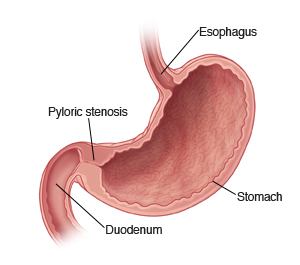
The pylorus is the opening between the stomach and the small intestine. Food passes out of the stomach through this opening. It acts like a valve controlling the passage of food from the stomach to the first part of the small intestine (duodenum). Pyloric stenosis is narrowing of this opening. This can block the passage of food out of the stomach.
The problem is often first seen in young babies. They are generally well at birth but start showing symptoms by the time they are 3 to 6 weeks of age. The baby may start vomiting after feeding. The vomiting may be very forceful (projectile vomiting). This may result in dehydration and weight loss.
The healthcare provider takes a detailed medical history, including birth history, from the caregivers, performs a physical exam of the baby and may request certain tests, such as bloodwork and ultrasound may be done. An ultrasound uses painless sound waves to create an image of the child’s stomach and intestine. An X-ray of the abdomen may be needed in some cases.
If pyloric stenosis is found, it's usually treated with surgery. This makes the opening wider and corrects the problem.
Home care
To help prevent vomiting after feedings:
-
Burp your baby several times during and after feeding.
-
Don't feed your baby lying down.
-
Don't overfeed. Wait at least 2 to 3 hours between feedings. This prevents pressure on the stomach opening.
-
Keep your baby in an upright position during feeding and for a half hour after each feeding. You can use a front-pack, backpack, infant swing or infant car seat to keep your baby upright.
-
Don't put tight diapers on your child. They put pressure on the abdomen.
-
Lay your baby on their back or side to sleep. Never put your baby to sleep on their stomach.
Follow-up care
Follow up with your child's healthcare provider as advised.
When to get medical advice
Call the healthcare provider if your baby has any of the following:
-
Severe coughing spell or trouble breathing
-
Unusual fussiness or drowsiness
-
Signs of dehydration, including no wet diapers for 8 hours, no tears when crying, sunken eyes or dry mouth
-
Watery or bloody diarrhea
-
Yellowing of the skin or eyes (jaundice)
-
Symptoms get worse or your baby has new symptoms
Online Medical Reviewer: Heather M Trevino BSN RNC
Online Medical Reviewer: Robyn Zercher FNP
Online Medical Reviewer: Shaziya Allarakha MD
Date Last Reviewed: 09/01/2024
© 2000-2026 The StayWell Company, LLC. All rights reserved. This information is not intended as a substitute for professional medical care. Always follow your healthcare professional's instructions.
Need Help? We're Here for You
Our Member Services team is here to help you understand your benefits, find care, or resolve concerns.
1-800-510-9132
Call NC Quitline
Need support to quit smoking, vaping, or to quit other nicotine products? You can receive support including medicines free of charge:
1-800-784-8669
Schedule Transportation
Need transportation to a doctor's office, pharmacy, or other covered healthcare service? Contact us to arrange your ride.
1-800-510-9132
Provider Directory
Need to find a provider like a Primary Care Physician, Specialist, OB/GYN, or a Psychiatrist?
Provider DirectoryRelated Articles
When Your Child Has Celiac Disease
Celiac disease is a problem that affects your child's ability to get nutrients from food. It is caused by a sensitivity to gluten. This is a protein found in many grains. Celiac cannot be cured, but it can be managed and the damage reversed.
Treating Celiac Disease in Children
To treat celiac disease, remove all sources of gluten from your child's diet. It's important to do this even if your child is not feeling sick. Removing gluten will prevent symptoms and health problems caused by celiac disease.
What is Ulcerative Colitis?
Ulcerative colitis causes inflammation and sores (ulcers) in the inner lining of the rectum and colon. It is a form of inflammatory bowel disease (IBD). Read on to learn about how this condition is diagnosed and treated.
When Your Child Has Dysphagia
Children with dysphagia have problems swallowing food or liquids. It often affects children who are just learning to eat solid foods. It can make it hard for your child to get enough nutrients for good growth. Read on to learn more.


