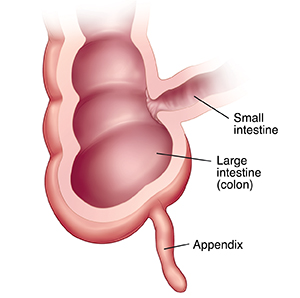
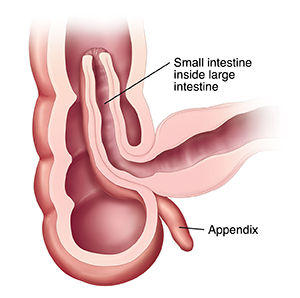
The bowel (intestine) is a very long tube. It's coiled up inside the belly (abdomen). Intussusception occurs when a part of the bowel slides inside another part. The bowel can slide back out by itself. Or it can get stuck. Blood flow to part of the bowel could then be blocked. This can cause severe harm if not treated. Intussusception can happen anywhere in the bowel. It’s most common near where the large intestine and small intestine meet. Most cases of intussusception occur by age 3 years.
What are the symptoms of intussusception?
Intussusception is very painful. Symptoms often occur suddenly. They may continue if the bowel gets stuck inside the other part. Or symptoms may go away and come back if part of the bowel keeps sliding in and out of the other part. Symptoms may include:
-
Severe belly pain (a baby may cry and not be soothed).
-
Belly pain that is sudden and gets worse, then goes away for 15 to 20 minutes, then comes back. These pain episodes become more frequent and more severe over time.
-
Vomiting. The vomit may have green bile in it.
-
Bloody stools with mucus in them.
-
Swelling of the belly.
-
Diarrhea.
-
Signs of dehydration, such as less urine, dark urine, dry mouth, or no tears when crying.
-
Changed mental state as symptoms get worse. The child may be extremely sleepy and slow to respond to you.
How is intussusception diagnosed?
Your child’s doctor will ask about your child’s symptoms and health history. They will give your child a physical exam. Your child may then have imaging tests to help see inside the belly. These may include:
-
Abdominal X-ray.
-
CT scan.
-
MRI.
-
Abdominal ultrasound.
-
Fluid or air enema. Either a contrast liquid or air is inserted into the rectum through the anus. This makes the bowel show up very clearly when a special scan is done.
How is intussusception treated?
To treat the problem, a fluid or air enema may be done. The force of the fluid or air entering the bowel can straighten it. Most cases are treated this way.
If the fluid or air enema doesn't work, surgery must be done. During surgery, the slipped portion of the bowel is straightened. If there is any damage to the bowel, that part of the bowel may need to be removed. The healthy ends of the bowel are then reattached.
What are the long-term concerns?
Most children do well after treatment. If part of the bowel must be removed, your child could have long-term digestive problems. But this is very rare. Your child’s doctor will tell you more. Even after it’s treated, intussusception could happen again. You’ll need to watch for symptoms. As your child gets older, intussusception is less likely to happen.
When intussusception goes away and comes back
Intussusception is an emergency if a part of the bowel gets stuck. But the problem can come and go. This means that the bowel slides inside itself, then slides back into correct position. Tests can only see the problem when it is happening. If the bowel has returned to normal position at the time of the test, the doctor can’t diagnose it at that time. If your child has symptoms again, they need to return to the doctor or the emergency room.
Featured in
Online Medical Reviewer: Chelsey Schilling BSN RN
Online Medical Reviewer: Daphne Pierce-Smith RN MSN
Online Medical Reviewer: Lalitha Kadali
Date Last Reviewed: 06/01/2025
© 2000-2026 The StayWell Company, LLC. All rights reserved. This information is not intended as a substitute for professional medical care. Always follow your healthcare professional's instructions.
Need Help? We're Here for You
Our Member and Recipient Services Team is here to help you understand your benefits, find care, or resolve concerns.
800-510-9132
Call NC Quitline
Need support to quit smoking, vaping, or to quit other nicotine products? You can receive support including medicines free of charge:
800-784-8669
Schedule Transportation
Need transportation to a doctor's office, pharmacy, or other covered healthcare service? Contact us to arrange your ride.
800-510-9132
Provider Directory
Need to find a provider like a Primary Care Physician, Specialist, OB/GYN, or a Psychiatrist?
Provider DirectoryRelated Articles
Biliary Atresia in Children
Biliary atresia is a rare liver disease that occurs in infants. It is often found shortly after birth. The disorder affects tubes in the liver called bile ducts. If not treated with surgery, it can be fatal.
When Your Child Has Dysphagia
Children with dysphagia have problems swallowing food or liquids. It often affects children who are just learning to eat solid foods. It can make it hard for your child to get enough nutrients for good growth. Read on to learn more.
Salmonella Gastroenteritis (Baby/Toddler)
Children can get salmonella from eating certain foods or water that has come into contact with the feces of an infected animal or person. Here's how to care for your child at home and what to watch for.
When Your Child Has Hirschsprung Disease
In a child with Hirschsprung's disease, nerves are missing in the anus and rectum and in part or all of the colon. The part of the colon without nerves can't relax. So, stool can't leave the body.


