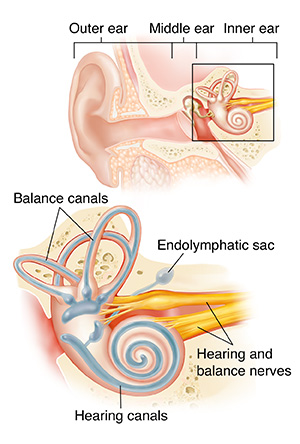
There are 2 parts of the inner ear. One part (hearing canal or cochlea) is for hearing. The other part (balance canals, or semi-circular canals) is for balance.
The canals are filled with a fluid called endolymph. A small organ called the endolymphatic sac keeps the level of this fluid up. In the hearing canal, sound waves cause vibrations in the endolymph. The inner ear detects these sound waves. It then sends nerve signals to the brain. The sound we hear is a result of how the brain interprets these nerve signals.
In the balance canals, a change in position causes the fluid to move. This movement is detected in the balance part of the inner ear. Nerve signals are then sent to the brain.
The balance canals collect balance information. The hearing canal collects sound information. The hearing and balance nerves carry this information to the brain from both parts of the inner ear.
Online Medical Reviewer: Ashutosh Kacker MD
Online Medical Reviewer: Ronald Karlin MD
Online Medical Reviewer: Tara Novick BSN MSN
Date Last Reviewed: 08/01/2023
© 2000-2026 The StayWell Company, LLC. All rights reserved. This information is not intended as a substitute for professional medical care. Always follow your healthcare professional's instructions.
Need Help? We're Here for You
Our Member and Recipient Services Team is here to help you understand your benefits, find care, or resolve concerns.
800-510-9132
Call NC Quitline
Need support to quit smoking, vaping, or to quit other nicotine products? You can receive support including medicines free of charge:
800-784-8669
Schedule Transportation
Need transportation to a doctor's office, pharmacy, or other covered healthcare service? Contact us to arrange your ride.
800-510-9132
Provider Directory
Need to find a provider like a Primary Care Physician, Specialist, OB/GYN, or a Psychiatrist?
Provider DirectoryRelated Articles
Anatomy of the Ear
This helpful article and diagram explain how all the parts of the ear work together.
Understanding Nasal Anatomy: Outside View
Why does your nose look the way it does? And what goes on inside a nose to let a person breathe easily? Learning the anatomy of the nose can help you better understand the answers to these questions.
What Is Dysarthria?
Learn about dysarthria, a speech problem due to muscle weakness in the face, lips, tongue, throat, and breathing muscles.
Parts of the Throat and Neck
Here are details and images of different parts of the throat and neck.


