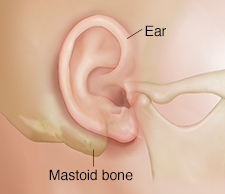
Mastoidectomy can remove infected bone and growths from the middle ear. But it may not always improve your hearing in the affected ear. The mastoid bone is located and can be felt behind the ear. During surgery, you'll get general anesthesia. The surgery may be done along with a tympanoplasty (eardrum repair) or an ossicular chain reconstruction (repair of the tiny bones behind the eardrum).
Infection and growths
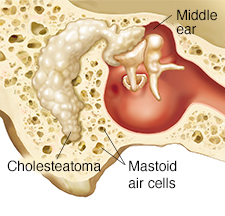
The mastoid bone contains cells that hold air (called air cells). Problems occur when an ear infection spreads to the air cells. Skin cells may also build up in an infected ear. These skin cells can form a growth (cholesteatoma). This growth can destroy nearby bone. If not treated, mastoid bone problems may cause deafness, facial nerve damage, dizziness, brain infection, or even death.
Removing mastoid bone
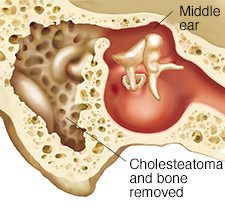
To reach the mastoid bone, your surgeon makes a cut (incision) behind the ear. They may go through the ear canal. Both approaches may be used together. Infected bone and any growths are removed. Then the incision is closed with stitches. There are many types of mastoidectomy. Each type is based on the amount of infected bone. Your surgeon will explain why a certain approach is best for your situation.
Online Medical Reviewer: Chris Southard RN
Online Medical Reviewer: Marianne Fraser MSN RN
Online Medical Reviewer: Ronald Karlin MD
Date Last Reviewed: 03/01/2024
© 2000-2026 The StayWell Company, LLC. All rights reserved. This information is not intended as a substitute for professional medical care. Always follow your healthcare professional's instructions.
Need Help? We're Here for You
Our Member and Recipient Services Team is here to help you understand your benefits, find care, or resolve concerns.
800-510-9132
Call NC Quitline
Need support to quit smoking, vaping, or to quit other nicotine products? You can receive support including medicines free of charge:
800-784-8669
Schedule Transportation
Need transportation to a doctor's office, pharmacy, or other covered healthcare service? Contact us to arrange your ride.
800-510-9132
Provider Directory
Need to find a provider like a Primary Care Physician, Specialist, OB/GYN, or a Psychiatrist?
Provider DirectoryRelated Articles
Earwax Removal
Sometimes the ear canal may contain too much wax. This can affect your hearing and can cause itching. But you shouldn't remove earwax unless it is causing a problem.
Nasal Packing, Dissolving
A nasal packing controls bleeding by helping the blood clot.
Ossicular Chain Reconstruction: Three Bones
This surgery can improve conductive hearing. In some cases, all 3 middle ear bones are replaced.
Parts of the Throat and Neck
Here are details and images of different parts of the throat and neck.


