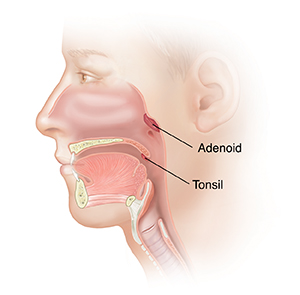
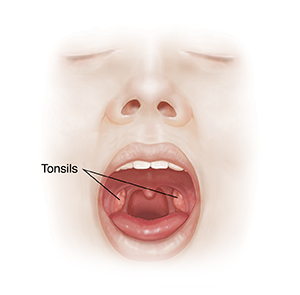
Tonsils and adenoids are clusters of lymph tissues in the back of the throat. These tissues form part of the body’s immune system, which helps the body fight disease. If these structures often become infected or become enlarged, it can lead to problems. They may then need to be removed with surgery. Surgery to take out the tonsils is called tonsillectomy. In some cases, the adenoids are also taken out. This is called adenoidectomy.
Why tonsillectomy and adenoidectomy are done
You may have your tonsils, adenoids, or both removed for reasons such as:
-
Infection of the tonsils (tonsillitis) that keeps coming back.
-
Repeated infections of the throat.
-
Enlargement of the tonsils or adenoids that affects breathing during sleep. This causes a condition called obstructive sleep apnea.
-
Suspected cancer of the throat.
Tonsillectomy can remove part or all of the tonsils.
How tonsillectomy and adenoidectomy are done
This surgery is done in a hospital or surgery center. It often takes less than an hour.
-
An intravenous (I.V.) line is put into a vein in your arm or hand. This gives you fluids and medicines.
-
You are given general anesthesia to put you into a deep sleep during the procedure.
-
A special device is used to hold your mouth open. A tube is put down into your throat to help keep your airway open during the procedure.
-
The doctor uses surgical tools to take out the tonsils and possibly the adenoids.
-
After you are awake and recovered from the anesthesia, you are sent home.
Risks of tonsillectomy and adenoidectomy
Risks include:
-
Bleeding.
-
Electric burns of the mouth and lip.
-
Infection.
-
Injury to the lips or teeth.
-
Numbness of the tongue.
-
Nausea and vomiting.
-
Risks of anesthesia.
-
The need for a second surgery.
-
Voice changes.
Author: Michels, Karen
Online Medical Reviewer: Ashutosh Kacker MD
Online Medical Reviewer: Ronald Karlin MD
Online Medical Reviewer: Tara Novick BSN MSN
Date Last Reviewed: 08/01/2025
© 2000-2026 The StayWell Company, LLC. All rights reserved. This information is not intended as a substitute for professional medical care. Always follow your healthcare professional's instructions.
Need Help? We're Here for You
Our Member and Recipient Services Team is here to help you understand your benefits, find care, or resolve concerns.
800-510-9132
Call NC Quitline
Need support to quit smoking, vaping, or to quit other nicotine products? You can receive support including medicines free of charge:
800-784-8669
Schedule Transportation
Need transportation to a doctor's office, pharmacy, or other covered healthcare service? Contact us to arrange your ride.
800-510-9132
Provider Directory
Need to find a provider like a Primary Care Physician, Specialist, OB/GYN, or a Psychiatrist?
Provider DirectoryRelated Articles
Nasal Surgery: Septoplasty
You're scheduled to have a type of nasal surgery called septoplasty. Read on to learn about what to expect during and after this surgery.
Ossicular Chain Reconstruction: 1 or 2 Bones
This surgery can improve conductive hearing. It can be done to replace a damaged malleus or incus bone.
Ossicular Chain Reconstruction: Three Bones
This surgery can improve conductive hearing. In some cases, all 3 middle ear bones are replaced.
Cochlear Implant Surgery
A cochlear implant is a device that helps reverse nerve-related hearing loss. It can treat hearing loss that will not respond to hearing aids. During cochlear implant surgery, the device is implanted into the inner ear (cochlea). A few weeks after surgery, the device is turned on and hearing is restored.