Your eardrum is a thin membrane between your outer and middle ear. Sound waves entering your ear cause the membrane to vibrate. This helps you hear. An injury or infection can cause your eardrum to tear (rupture). This creates a hole (perforation) that may affect your hearing.
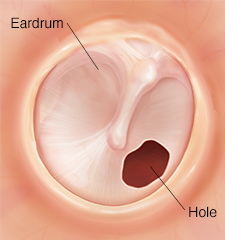
Causes of eardrum perforation
Causes of a ruptured eardrum include:
-
Pressure from an ear infection.
-
Putting an object, such as a cotton swab, bobby pin, or pencil, into the ear.
-
A very loud noise, such as a gunshot or explosion, close to the ear.
-
Rapid changes in air pressure, which can happen during scuba diving or traveling at high altitudes.
-
A slap or blow to the ear.
When to go to the emergency room (ER)
Get medical care right away if you:
-
Have severe pain, bleeding, or ringing in your ear.
-
Lose your hearing suddenly.
-
Become very dizzy for no reason.
-
Have an object lodged in your ear.
A ruptured eardrum from an ear infection usually isn't an emergency. In fact, the rupture often relieves pressure and pain. It usually heals within hours or days. But you should have the ear looked at by a doctor within 24 hours.
What to expect in the ER
Your ear will be examined. Treatment will depend on how bad the damage is. Small holes often heal on their own. A small patch may be placed over a minor eardrum tear. Large tears may need to be repaired during an operation. You will be told how to keep the ear canal dry until it has healed.
Ways to prevent eardrum rupture
Don't clean inside the ear canal with cotton swabs or any other object. Wear hearing protection when working in high noise areas, such as factories, underground mines, or shooting ranges.
Online Medical Reviewer: Melinda Murray Ratini DO
Online Medical Reviewer: Riley Holtz RN BS
Date Last Reviewed: 06/01/2025
© 2000-2026 The StayWell Company, LLC. All rights reserved. This information is not intended as a substitute for professional medical care. Always follow your healthcare professional's instructions.
Need Help? We're Here for You
Our Member and Recipient Services Team is here to help you understand your benefits, find care, or resolve concerns.
800-510-9132
Call NC Quitline
Need support to quit smoking, vaping, or to quit other nicotine products? You can receive support including medicines free of charge:
800-784-8669
Schedule Transportation
Need transportation to a doctor's office, pharmacy, or other covered healthcare service? Contact us to arrange your ride.
800-510-9132
Provider Directory
Need to find a provider like a Primary Care Physician, Specialist, OB/GYN, or a Psychiatrist?
Provider DirectoryRelated Articles
Vocal Cord Dysfunction (VCD)
Learn details about vocal cord dysfunction (VCD), including causes, symptoms, diagnosis, treatment, and prevention.
Vertigo (Unknown Cause)
Problems with the inner ear can cause a false feeling of motion called vertigo. Learn about the possible causes, self-care, and when to get medical help.
Deviated Septum
A deviated septum may cause congestion, problems with breathing, or nasal discharge. Here's what to know about this condition.
Foreign Body in the Ear Canal
A foreign body in the ear can lead to irritation. Sometimes this can cause infection in the outer ear canal.


