
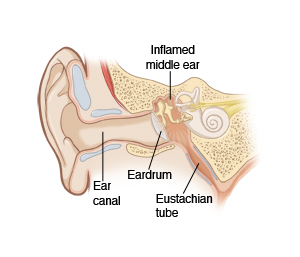
You have an infection of the middle ear, the space behind the eardrum. It's also called acute otitis media (AOM). It can follow a cold or allergies. This is because congestion from either can block the internal passage (eustachian tube) that drains fluid from the middle ear. When the middle ear fills with fluid, bacteria can grow there and cause an infection. Oral antibiotics are used to treat this illness. Symptoms often start to improve within 1 to 2 days of treatment.
Home care
Here are some general care guidelines:
-
If your doctor prescribed antibiotics, take them as directed. Do not stop taking them just because you feel better. You need to take the full course of antibiotics.
-
You may use over-the-counter medicine, such as acetaminophen or ibuprofen, to control pain and fever unless something else is prescribed. Talk with your doctor before using these medicines if you have chronic liver or kidney disease. Also talk with your doctor if you've had a stomach ulcer or digestive tract bleeding or take a blood thinner.
-
Don't give aspirin to children or teens unless your child’s doctor says it is safe. Aspirin can put your child at risk for Reye syndrome, a rare but serious condition.
Follow-up care
Follow up with your doctor as advised. If all symptoms haven't gotten better, or if your hearing doesn't go back to normal in 2 weeks, you may need further treatment.
When to contact your doctor
Contact your doctor right away if:
-
You have a seizure. Call 911 if this is the first time you have had a seizure.
-
Your ear pain gets worse or doesn't improve after 3 days of treatment.
-
You have abnormal drowsiness or confusion.
-
You have neck pain, a stiff neck, or headaches.
-
Fluid or blood is draining from the ear canal.
-
You have a fever of 100.4°F (38°C) or higher, or as advised.
Online Medical Reviewer: Daphne Pierce-Smith RN MSN
Online Medical Reviewer: Melinda Murray Ratini DO
Online Medical Reviewer: Sravani Chintapalli Researcher
Date Last Reviewed: 04/01/2025
© 2000-2026 The StayWell Company, LLC. All rights reserved. This information is not intended as a substitute for professional medical care. Always follow your healthcare professional's instructions.
Need Help? We're Here for You
Our Member and Recipient Services Team is here to help you understand your benefits, find care, or resolve concerns.
800-510-9132
Call NC Quitline
Need support to quit smoking, vaping, or to quit other nicotine products? You can receive support including medicines free of charge:
800-784-8669
Schedule Transportation
Need transportation to a doctor's office, pharmacy, or other covered healthcare service? Contact us to arrange your ride.
800-510-9132
Provider Directory
Need to find a provider like a Primary Care Physician, Specialist, OB/GYN, or a Psychiatrist?
Provider DirectoryRelated Articles
Acute Viral Pharyngitis (Sore Throat)
Learn about the symptoms of a sore throat from a virus and how to care for a sore throat at home.
Sinus Headache
Learn how to care for a sinus headache at home.
Pharyngitis: Strep (Confirmed)
Strep throat is a contagious illness. It is spread by coughing, kissing, or by touching others after touching your mouth or nose.
Understanding Acute Rhinosinusitis
Acute rhinosinusitis is when the lining of the inside of the nose and the sinuses becomes irritated and swollen. It is also called sinusitis, or a sinus infection.


