Follow these first aid steps when someone is choking. You may hear these steps called the abdominal (belly) thrust maneuver or sometimes by the older name, Heimlich maneuver.
Call 911
Call
Step 1. Identify choking
- Ask the person if they are choking. If they can't cough or speak, say that you will help.
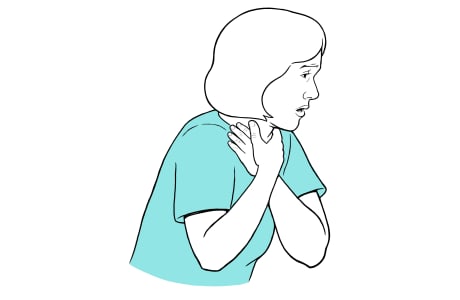
Step 2. Grasp from behind
- If the person is an adult or a child age 1 year or older, move behind them. Slide your palms under their arms, bringing your hands together in front of their body.
- Make a fist with one hand, placing the flat surface of the thumb and first finger slightly above the bellybutton.
- Note: If pregnancy or extreme overweight makes this impossible, give thrusts inward against the middle of the person's breastbone.
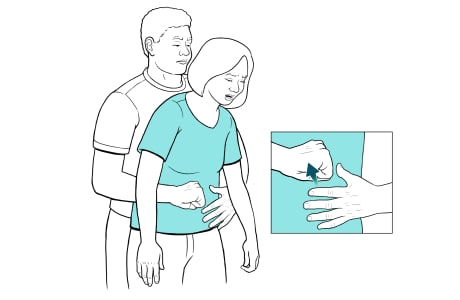
Step 3. Thrust in and up
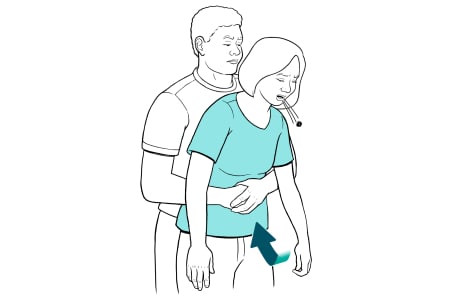
- Cover your fist with the other hand, keeping your elbows away from your body.
- Pull in and up quickly, using hard thrusts to force air from the person's lungs. This pops out the blockage.
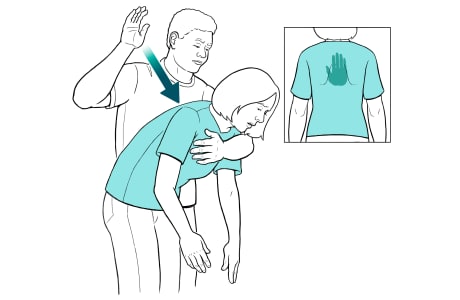
- Repeat thrusts 5 times. If the object is still stuck, have the person bend over so they are looking at the floor. With the heel of your hand, give 5 firm back blows between their shoulder blades.
- If they are still choking, continue with 5 abdominal thrusts and 5 back blows until the object comes out or the person faints.
Step 4. Proceed to CPR
- If the person becomes unresponsive, call for help and activate the emergency response system.
- Do CPR if you are trained.
Featured in
Online Medical Reviewer: Dan Brennan MD
Online Medical Reviewer: Liora C Adler MD
Online Medical Reviewer: Marianne Fraser MSN RN
Date Last Reviewed: 01/01/2025
© 2000-2026 The StayWell Company, LLC. All rights reserved. This information is not intended as a substitute for professional medical care. Always follow your healthcare professional's instructions.
Need Help? We're Here for You
Our Member and Recipient Services Team is here to help you understand your benefits, find care, or resolve concerns.
800-510-9132
Call NC Quitline
Need support to quit smoking, vaping, or to quit other nicotine products? You can receive support including medicines free of charge:
800-784-8669
Schedule Transportation
Need transportation to a doctor's office, pharmacy, or other covered healthcare service? Contact us to arrange your ride.
800-510-9132
Provider Directory
Need to find a provider like a Primary Care Physician, Specialist, OB/GYN, or a Psychiatrist?
Provider DirectoryRelated Articles
First Aid: Rescue Breathing
Rescue breathing is needed if a person collapses and stops breathing. In CPR, rescue breathing may also follow chest compressions if a person's heart is not beating. Know the steps.
First Aid for Poisonings in a Child
Sometimes accidental poisonings can be treated in the home under the direction of a poison control center or your child's doctor. At other times, emergency medical care is necessary. Read on to learn more.
Head Injury with Sleep Monitoring (Child)
Even if a head injury appears minor, symptoms of a more serious problem may appear later. You will need to watch your child for such symptoms.
Splinter Removal (Child)
A splinter is a very thin piece of material that is stuck deep in the skin. In most cases, after a splinter is removed, the wound left by the splinter closes on its own.


