A dacryocystorhinostomy (DCR) is surgery to create a new tear duct between your eye and nose. You may need this surgery if your own tear duct has become blocked. When this duct becomes blocked, tears can't drain correctly from the eye to the nose. As a result, you may have a lot of tearing, discharge, and sometimes recurrent eye infections.
How to say it
DA-kree-oh-SIHS-toh-ri-NAHS-tuh-mee
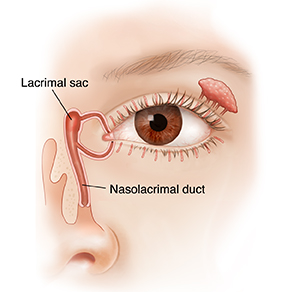
How tears drain from your eyes
Your eyelids have 2 small openings that drain tears from your eyes. When you blink, tears are pushed into these openings. Then the tears go through a small tube to the lacrimal sac. This sac leads into a tube called a tear duct (the nasolacrimal duct). This duct leads into your nose.
Why a dacryocystorhinostomy is done
Sometimes a tear duct can get blocked. This can cause the duct to get infected. It can swell and cause pain, mucus, and crusts around the eye. It also causes excess tearing from the eyes. DCR is done to relieve these symptoms. Your healthcare provider may suggest you have DCR if other treatments have not worked. These include warm compresses, massage, and antibiotics.
How dacryocystorhinostomy is done
Your surgery will most likely be done by a healthcare provider trained in ophthalmic plastic surgery. The surgery can be done in several ways. The provider will make a small cut (incision) below or near your eyelid. The cut is done under your eye and next to your nose. The provider will make a small hole in the bone in this area. This makes a new opening between the lacrimal sac and your nose. In some cases, a small tube (stent) may be put into the opening. It helps keep it open.
Risks of a dacryocystorhinostomy
All procedures have risks. The risks of this procedure include:
-
Infection
-
Too much bleeding
-
Movement of the small tube (stent) put in the duct
-
Tissue in the nose that grows together
-
A large scar on the face
-
Sinusitis
-
No change in symptoms
-
Need for more surgery.
Your risks may differ depending on your age, your general health, and the cause of your blocked duct. Ask your healthcare provider which risks apply most to you.
Online Medical Reviewer: Heather M Trevino BSN RNC
Online Medical Reviewer: Rajadurai Samnishanth
Online Medical Reviewer: Whitney Seltman MD
Date Last Reviewed: 08/01/2024
© 2000-2026 The StayWell Company, LLC. All rights reserved. This information is not intended as a substitute for professional medical care. Always follow your healthcare professional's instructions.
Need Help? We're Here for You
Our Member Services team is here to help you understand your benefits, find care, or resolve concerns.
1-800-510-9132
Call NC Quitline
Need support to quit smoking, vaping, or to quit other nicotine products? You can receive support including medicines free of charge:
1-800-784-8669
Schedule Transportation
Need transportation to a doctor's office, pharmacy, or other covered healthcare service? Contact us to arrange your ride.
1-800-510-9132
Provider Directory
Need to find a provider like a Primary Care Physician, Specialist, OB/GYN, or a Psychiatrist?
Provider DirectoryRelated Articles
Laser Photocoagulation for Age-Related Macular Degeneration (AMD)
Laser photocoagulation is a type of laser surgery used to treat age-related macular degeneration (AMD). AMD is a condition that can lead to vision loss.
Having Laser Photocoagulation for Age-Related Macular Degeneration (AMD)
Laser photocoagulation uses a laser to seal off abnormal blood vessels in your eye. This treatment can’t restore eyesight that you already have lost. But it may slow down the damage to your central vision.
Particle in the Eye
A conjunctival foreign body is a very small object, such as an eyelash or dirt, that has become trapped under the eyelid. This can be very irritating to the eye, no matter how small the object is.
Cataract Treatment: Removing the Cloudy Lens
Cataract surgery involves removing the cataract and replacing the lens. Here are the two most common ways that cataracts are removed.