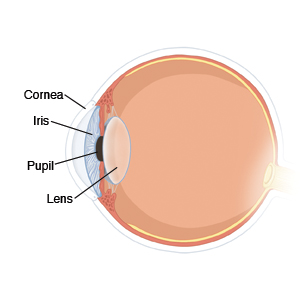
The iris is the colored part of the eye that controls the size of the pupil. Iritis is an inflammation of the iris. It can be caused by injury to the eye or disease elsewhere in the body. Diseases linked to iritis include Lyme disease, inflammatory bowel disease, and rheumatoid arthritis. Often, no cause is found.
Iritis usually develops suddenly in one eye. Symptoms include redness, pain in the eye or brow area, sensitivity to light, and blurred vision.
Iritis is treated with eye drops to dilate the pupil and reduce pain. This will cause your vision to be blurred from a few hours up to a week, depending on the medicine used. Steroid drops are also prescribed to reduce pain from inflammation. Iritis from eye injury usually resolves in 1 to 2 weeks. Iritis from other causes may take several weeks to months to resolve.
Home care
-
Use eye drops as prescribed.
-
Wear sunglasses to decrease light sensitivity and discomfort.
-
If your eye is dilated or if you have been given an eye patch, your driving ability will be affected. Don't drive until the blurred vision wears off and you no longer need an eye patch.
-
You may use acetaminophen or ibuprofen to control pain, unless another medicine was prescribed. Talk with your healthcare provider before taking these medicines if you have chronic liver or kidney disease, or if you have ever had a stomach ulcer or digestive bleeding.
Follow-up care
Follow up with your healthcare provider, or as advised.
When to get medical advice
Contact your healthcare provider right away if any of the following occur:
-
Symptoms don’t start to improve after 1 week
-
Iritis from eye injury causes symptoms for more than 2 weeks
-
Pain increases
-
You lose some or all of your vision
Online Medical Reviewer: Chris Haupert MD
Online Medical Reviewer: Tara Novick BSN MSN
Online Medical Reviewer: Whitney Seltman MD
Date Last Reviewed: 12/01/2022
© 2000-2026 The StayWell Company, LLC. All rights reserved. This information is not intended as a substitute for professional medical care. Always follow your healthcare professional's instructions.
Need Help? We're Here for You
Our Member and Recipient Services Team is here to help you understand your benefits, find care, or resolve concerns.
800-510-9132
Call NC Quitline
Need support to quit smoking, vaping, or to quit other nicotine products? You can receive support including medicines free of charge:
800-784-8669
Schedule Transportation
Need transportation to a doctor's office, pharmacy, or other covered healthcare service? Contact us to arrange your ride.
800-510-9132
Provider Directory
Need to find a provider like a Primary Care Physician, Specialist, OB/GYN, or a Psychiatrist?
Provider DirectoryRelated Articles
Nystagmus
Nystagmus is abnormal eye movement that can't be controlled. Some treatment options may help reduce symptoms, but they won't stop the problem completely.
What Are Retinal Tears and Detachments?
The retina is the inside lining of the eye. It turns light into nerve signals. These signals are then sent to the brain where they become the images you see. The retina may be torn or detached due to aging, an eye injury, or other problems. Tears and detachments are painless.
Ptosis
Ptosis is when the upper eyelid droops down more than it should. If the ptosis is severe, it may block vision.
Color Blindness
Color blindness is when you can't see colors in a normal way. It does not mean you can't see any colors at all.


