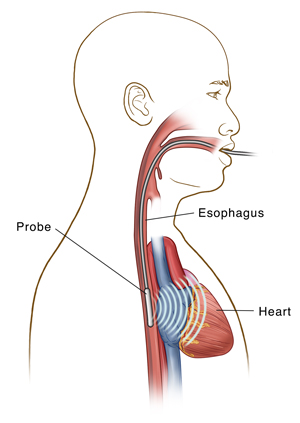
Transesophageal echocardiography (TEE) is a test done to record images of your heart with a probe inside your throat (esophagus). These images help your healthcare provider find and treat problems, such as infection, disease, or defects in your heart’s function, walls, or valves. This test may be done when a chest echocardiogram (transthoracic) doesn't give your provider enough information.
Before your test
-
Tell your healthcare provider about all the medicines you take. Ask if you should take them before the test. Your stomach typically should be empty for this test to prevent vomiting, so your provider will likely tell you not to take them.
-
Follow any directions you're given for not eating or drinking before the procedure.
-
Tell your provider if you have ulcers, a hiatal hernia, or problems swallowing. Also report a history of narrowing of the esophagus, or any other past gastrointestinal problems. A smaller probe may be needed for your study.
-
Let the provider know of any allergies to medicines or sedatives.
-
Also let them know if you have dental implants or dentures that should be removed before the test.
-
Arrange to have someone drive you home after the exam. You'll be given a sedative for the test. It won't be safe to drive for a period of time.
During your TEE
-
When you arrive for your TEE, you'll change into a hospital gown, and then be taken to the testing room.
-
Your provider will spray your throat with a numbing medicine. You may be given a medicine through an IV (intravenous) line in your arm to help you relax. You may also be given oxygen. Then you’ll be asked to lie on your left side.
-
The healthcare provider gently puts the small, lubricated probe into your mouth. A small plastic or rubber bite-block will be put in your mouth to prevent you from biting down on the probe during the test. As you swallow, the provider will slowly guide the tube into your esophagus.
-
You may feel the healthcare provider moving the probe. But it shouldn’t hurt or interfere with your breathing. A nurse checks your heart rate, blood pressure, and breathing. The test usually takes about 15 minutes.
-
The nurse or assistant will suction any saliva out of your mouth, similar to when you have a dental cleaning.
After the test
-
Tell your healthcare provider about any pain. Let them know if you cough up or vomit blood, or have trouble swallowing.
-
Your throat may be sore for a few hours. You can eat and drink again when your throat is no longer numb and you're fully awake.
-
Don't drive a car or run heavy machinery for at least 24 hours after getting sedation. Most people can return to normal activities after 24 hours. Ask your healthcare provider when it's safe for you to return to normal activities.
-
Keep your follow-up appointment to go over the results with your healthcare provider.
-
Your next appointment is: ____________________
Online Medical Reviewer: Robyn Zercher FNP
Online Medical Reviewer: Stacey Wojcik MBA BSN RN
Online Medical Reviewer: Steven Kang MD
Date Last Reviewed: 03/01/2024
© 2000-2026 The StayWell Company, LLC. All rights reserved. This information is not intended as a substitute for professional medical care. Always follow your healthcare professional's instructions.
Need Help? We're Here for You
Our Member and Recipient Services Team is here to help you understand your benefits, find care, or resolve concerns.
800-510-9132
Call NC Quitline
Need support to quit smoking, vaping, or to quit other nicotine products? You can receive support including medicines free of charge:
800-784-8669
Schedule Transportation
Need transportation to a doctor's office, pharmacy, or other covered healthcare service? Contact us to arrange your ride.
800-510-9132
Provider Directory
Need to find a provider like a Primary Care Physician, Specialist, OB/GYN, or a Psychiatrist?
Provider DirectoryRelated Articles
Stress Myocardial Perfusion Scan
Myocardial perfusion is an imaging test. It's also called a nuclear stress test. It's done to show how well blood flows through the heart muscle. It also shows how well the heart muscle is pumping.
Fluoroscopy Procedure
Fluoroscopy is a type of imaging tool. It looks at moving body structures. It’s much like an X-ray "movie."
Electrocardiogram (ECG)
The ECG is a test that records electrical signals from your heart. The pattern of these signals can tell the healthcare provider if your heart is normal, under stress, or having electrical problems, strain, or damage.
Tilt Table Testing
Tilt table testing is a simple test that helps the doctor find the cause of your fainting. It checks how changes in body position can affect your blood pressure. Read on to learn more.