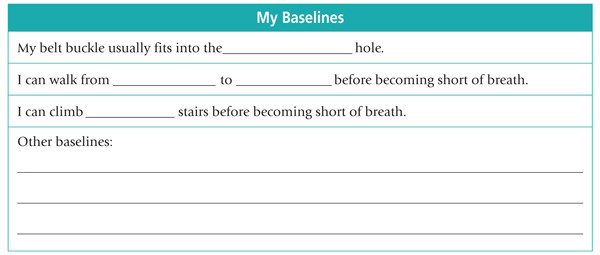
The first step to managing heart failure symptoms is getting to know what’s normal for you. How much can you usually do before shortness of breath is a problem? Do your socks and shoes fit comfortably? How much do you weigh? How your symptoms usually feel are your baselines. Knowing what’s normal for you will help you see when symptoms are getting worse. You’ll know because you won’t feel normal anymore. Symptoms that get worse means your heart is under stress. It's having a hard time pumping blood to the rest of your body, and your body may be retaining fluid. Write some baselines in the box below. These will help you measure your symptoms.

Watch for changes
Once you’ve come up with baselines, watch for changes daily. Pay attention to how much you can do today. Is it the same as yesterday? Are your shoes tight? Do you need to use a different belt hole? Can you lie flat in bed to sleep without feeling that you are suffocating? Can you eat without feeling full too soon, or short of breath? Are you gaining weight but eating the same amount?
If today’s symptoms are different from your baselines, you need to take action. The problem won’t go away by itself. So, if you notice even a small change, don’t ignore it. Your health care provider is counting on you to call when you think your symptoms are worse. They will tell you what to do next. Working together this way helps keep heart failure under control and improves the number of good days you have. It could even keep you out of the hospital.
Online Medical Reviewer: Ronald Karlin MD
Online Medical Reviewer: Stacey Wojcik MBA BSN RN
Online Medical Reviewer: Steven Kang MD
Date Last Reviewed: 02/01/2025
© 2000-2026 The StayWell Company, LLC. All rights reserved. This information is not intended as a substitute for professional medical care. Always follow your healthcare professional's instructions.
Need Help? We're Here for You
Our Member and Recipient Services Team is here to help you understand your benefits, find care, or resolve concerns.
800-510-9132
Call NC Quitline
Need support to quit smoking, vaping, or to quit other nicotine products? You can receive support including medicines free of charge:
800-784-8669
Schedule Transportation
Need transportation to a doctor's office, pharmacy, or other covered healthcare service? Contact us to arrange your ride.
800-510-9132
Provider Directory
Need to find a provider like a Primary Care Physician, Specialist, OB/GYN, or a Psychiatrist?
Provider DirectoryRelated Articles
Heart Failure: Being Active
Being active doesn't mean that you have to wear yourself out. Even a little movement each day helps to strengthen your heart. If you can't get out to exercise, you can do simple stretching and strengthening exercises at home. Read on for helpful tips to be a bit more active.
Checking Your Own Blood Pressure
You can purchase your own blood pressure monitor and check the reading yourself at home. Here's how.
8 Mistakes Heart Patients Make
The way you respond to a heart attack can make a big difference in what happens to you in the future.
Taking ACE Inhibitors
ACE inhibitors widen blood vessels and increase the amount of blood your heart pumps. These medications also lower blood pressure and decrease the amount of work your heart has to perform.