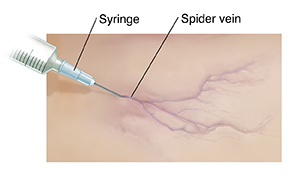
The most common way to treat spider and small varicose veins is sclerotherapy. This is a simple office procedure. After treatment, you can return to your daily activities right away. For best results, some veins may need to be treated more than once.
What sclerotherapy does
This treatment causes spider and small varicose veins to disappear over time. It's done by injecting the veins with a chemical that causes them to scar and collapse. The body then reroutes the blood to flow only through the healthy veins. Over time, the treated veins go away. Sclerotherapy will not prevent new spider and varicose veins from forming.
What this treatment involves
Your doctor may use an ultrasound machine to help them find the veins to treat. They will inject the veins using a fine needle. In most cases, this isn’t painful. You may feel a slight burning or stinging. Many veins can be treated in a single session.
After treatment, the injection sites are covered with gauze and tape. You may also have to wear bandages or elastic stockings, as directed.
Recovering at home
At first, your legs will most likely be bruised. For a brief time, they may even look worse than they did before treatment. But you can expect to see good results in 6 to 8 weeks. For the best outcome, here are some helpful hints:
-
Wear elastic stockings or bandages as directed.
-
Raise your legs as advised, to help reduce swelling.
-
Walk each day to increase blood flow.
-
Follow your doctor’s advice about other kinds of exercise.
When to contact your doctor
Contact your doctor right away if you notice:
-
Pain in your legs or feet.
-
Bleeding at injection sites.
-
Extreme swelling or bruising.
-
Fever.
-
Chest pain.
-
Skin breakdown at the site of the injection.
Online Medical Reviewer: Daphne Pierce-Smith RN MSN
Online Medical Reviewer: Esther Adler
Online Medical Reviewer: Mahammad Juber Medical Researcher
Date Last Reviewed: 05/01/2025
© 2000-2026 The StayWell Company, LLC. All rights reserved. This information is not intended as a substitute for professional medical care. Always follow your healthcare professional's instructions.
Need Help? We're Here for You
Our Member and Recipient Services Team is here to help you understand your benefits, find care, or resolve concerns.
800-510-9132
Call NC Quitline
Need support to quit smoking, vaping, or to quit other nicotine products? You can receive support including medicines free of charge:
800-784-8669
Schedule Transportation
Need transportation to a doctor's office, pharmacy, or other covered healthcare service? Contact us to arrange your ride.
800-510-9132
Provider Directory
Need to find a provider like a Primary Care Physician, Specialist, OB/GYN, or a Psychiatrist?
Provider DirectoryRelated Articles
Endovenous Laser Varicose Vein Surgery
Endovenous laser varicose vein surgery is a procedure that uses heat from a laser to reduce varicose veins. Varicose veins are swollen, bulging veins that often happen on the thighs or calves. A laser is a device that sends a thin beam of radiation in the form of light.
Inferior Vena Cava (IVC) Filter Placement
An inferior vena cava (IVC) filter is a small device that can stop blood clots from going up into the lungs. The inferior vena cava is a large vein in the middle of your body. The device is put in during a brief surgery.
Understanding Percutaneous Transcatheter Treatment of Deep Vein Thrombosis (DVT)
Percutaneous transcatheter treatment is a way to treat a deep vein thrombosis (DVT). DVT is a blood clot that forms in a large, deep vein. It happens most often in one of the veins of your legs. You may have pain, swelling, warmth, and redness from the DVT.
Peripheral Angioplasty
Peripheral angioplasty is a procedure that helps open blockages in peripheral arteries. These vessels carry blood to your lower body, legs, and arms.