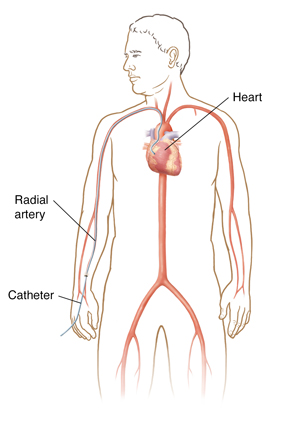
Cardiac catheterization (cardiac cath) is a common, nonsurgical procedure. During the procedure, your health care provider will insert a long, thin tube (catheter) into an artery and move it up into your heart. Transradial means the catheter is inserted into an artery in the wrist (the radial artery) rather than the groin (the femoral artery). This procedure can be used to diagnose and treat certain heart problems.
Why do I need a transradial cardiac cath?
You may need a cardiac cath if signs show a problem with your heart. These may include:
-
Symptoms of chest pain, tightness, or heaviness (known as angina). This is a common symptom of blocked heart arteries, known as coronary artery disease.
-
Symptoms of weakness, dizziness, trouble breathing, or swollen legs or feet. These may be symptoms of a problem with a heart valve or the heart muscle.
-
Other test results that show heart problems. Tests may include stress tests, heart scans, and echocardiography.
During a cardiac cath, your health care provider can see the condition of the coronary arteries and heart valves. They can also check how well the heart pumps and the flow of blood through the heart. Your provider can also measure pressures and take blood samples. And, if needed, they can open blocked arteries. This can help reduce symptoms of angina.
During transradial cardiac cath, the catheter is inserted into an artery in the wrist as opposed to the more traditional approach in the groin. This can mean less bleeding and a faster recovery. Some people may have blockages in the groin arteries as well as in the heart arteries, making it hard to reach the heart. The transradial approach can be used to get around this problem.
What happens during a transradial cardiac cath?
The procedure is done in the hospital or a surgery center. First, an I.V. line is put in your arm or hand to deliver fluids and medicines. You will likely be given medicine to relax you and make you drowsy. When the procedure starts:
-
You lie on an X-ray table.
-
The skin over the insertion site in your wrist is numbed.
-
The health care provider makes a tiny puncture or incision into the artery in the wrist. They then insert a catheter and thread it through the blood vessel into your heart.
-
The provider may inject a contrast fluid through the catheter into the arteries. This fluid makes the arteries show up better on X-rays.
-
Tests may be done to check the condition of your heart and arteries. If needed, the provider can clear blockages in the arteries or do other repairs.
-
When the provider is finished, they will remove the catheter and put pressure on the site to prevent bleeding. They might use a special device to reduce how long the pressure needs to be on. Or they might use an inflatable band to keep pressure on the site. Nursing staff will gradually reduce the pressure in the band after your procedure.
-
You will stay for a time to recover, and then you'll go home. If this was an emergency procedure, you will likely stay in the hospital at least overnight.
What are the risks of transradial cardiac cath?
Risks include:
-
Bleeding, bruising, infection, or blood clots.
-
Damage to the radial artery that may cause injury to the hand.
-
Nerve damage to the hand.
-
An allergic reaction to the contrast fluid.
-
An abnormal heartbeat (arrhythmia).
-
Damage to blood vessels or tissues.
-
Kidney damage or failure.
-
The need for emergency heart surgery.
-
Heart attack, stroke, or death.
Author: Michels, Karen
Online Medical Reviewer: Robyn Zercher FNP
Online Medical Reviewer: Stacey Wojcik MBA BSN RN
Online Medical Reviewer: Steven Kang MD
Date Last Reviewed: 03/01/2025
© 2000-2026 The StayWell Company, LLC. All rights reserved. This information is not intended as a substitute for professional medical care. Always follow your healthcare professional's instructions.
Need Help? We're Here for You
Our Member and Recipient Services Team is here to help you understand your benefits, find care, or resolve concerns.
800-510-9132
Call NC Quitline
Need support to quit smoking, vaping, or to quit other nicotine products? You can receive support including medicines free of charge:
800-784-8669
Schedule Transportation
Need transportation to a doctor's office, pharmacy, or other covered healthcare service? Contact us to arrange your ride.
800-510-9132
Provider Directory
Need to find a provider like a Primary Care Physician, Specialist, OB/GYN, or a Psychiatrist?
Provider DirectoryRelated Articles
Carotid Artery Problems: Surgery for TIA
You have narrowing of a blood vessel or carotid artery in your neck. It is caused by a substance called plaque that has built up in your artery. This can cause a transient ischemic attack or TIA. Here is information on surgery to help your condition.
Patent Foramen Ovale Transcatheter Repair
A patent foramen ovale (PFO) is a small hole between the 2 upper chambers of the heart, the right and the left atrium. Patent foramen transcatheter repair is a procedure to fix this hole in the heart. Read on for details about this procedure.
Catheter Ablation
This procedure guides a tube into your heart to destroy small areas of heart tissue that may be causing your abnormal heartbeat.
Having Pericardiocentesis
Pericardiocentesis is a procedure to remove fluid that has built up in the sac around the heart. Read on to learn details about what to expect before, during, and after this procedure.