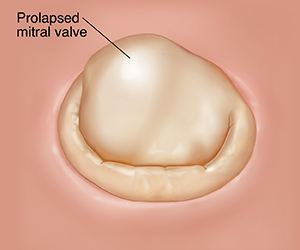
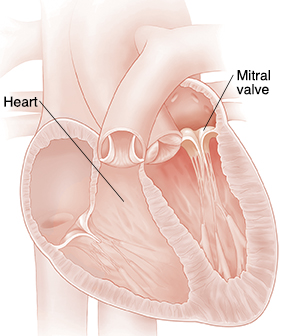
Mitral valve prolapse is the most common heart valve problem. With this condition, the valve that separates the left atrium and left ventricle doesn’t open and close as it should. Extra tissue in the valve can stop it from closing correctly. This can make the valve leaky.
Most cases of mitral valve prolapse aren't serious. Usually, only a small amount of blood leaks backward. This doesn't cause problems and doesn't need treatment. But sometimes a larger amount of blood can leak backward. This can lead to a serious problem, as the blood that leaks backward must be pumped twice. Over time, this takes a toll on the heart. You may need surgery to fix the valve if the heart starts to function poorly.
Symptoms of mitral valve prolapse
Mitral valve prolapse may not cause symptoms. If you do have symptoms, they may include:
-
Mild chest pain
-
Pounding or racing heart (palpitations)
-
Shortness of breath
-
Trouble breathing with activity
-
Fatigue
-
Migraine headaches
-
Fainting
Possible causes
Mitral valve prolapse is often present from birth. But some people can develop it later in life. In some cases, the condition is passed down from your parents (inherited).
Treating mitral valve prolapse
Most people with mitral valve prolapse have mild disease that doesn't get worse. It doesn't need to be treated. But sometimes the valves get more stretched out over time and can cause symptoms. Medicines can help ease symptoms.
Your healthcare provider may ask you to come in from time to time for tests to check your heart valve and to be sure the problem hasn’t gotten worse. In severe cases, surgery to fix or replace the valve may be needed.
Online Medical Reviewer: Ronald Karlin MD
Online Medical Reviewer: Stacey Wojcik MBA BSN RN
Online Medical Reviewer: Steven Kang MD
Date Last Reviewed: 04/01/2024
© 2000-2026 The StayWell Company, LLC. All rights reserved. This information is not intended as a substitute for professional medical care. Always follow your healthcare professional's instructions.
Need Help? We're Here for You
Our Member Services team is here to help you understand your benefits, find care, or resolve concerns.
1-800-510-9132
Call NC Quitline
Need support to quit smoking, vaping, or to quit other nicotine products? You can receive support including medicines free of charge:
1-800-784-8669
Schedule Transportation
Need transportation to a doctor's office, pharmacy, or other covered healthcare service? Contact us to arrange your ride.
1-800-510-9132
Provider Directory
Need to find a provider like a Primary Care Physician, Specialist, OB/GYN, or a Psychiatrist?
Provider DirectoryRelated Articles
Cardiac Sarcoma
Cardiac sarcoma is a rare type of cancerous tumor that occurs in the heart.
Clinical Guidelines for Heart Failure
As a patient, understanding the basics of the guidelines can help you take a more active role in your treatment.
Understanding Orthostatic Hypotension
Orthostatic hypotension is low blood pressure when you stand up from sitting or lying down. It can cause symptoms for such as dizziness, lightheadedness, and blurry vision. It may also cause fainting and falls.
Ventricular Arrhythmia
Sometimes problems with the heart's electrical signals lead to a fast heart rhythm. Too many signals may make the heart beat very fast (tachycardia). Or signals may be sent so rapidly and irregularly that the heart muscle sometimes quivers and doesn't beat at all (fibrillation).