You may have been told that you have an aneurysm. This is when a weakened part of a blood vessel expands like a balloon. An aneurysm in the main blood vessel in your stomach area is called an abdominal aortic aneurysm (AAA).
What is AAA?
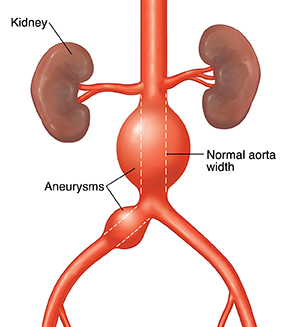
The aorta is the large artery that carries oxygenated blood from the heart to the rest of the body. With AAA, part of the aorta weakens and stretches. If an aneurysm gets large enough, it may burst. This is very serious, and usually fatal.
How is an aneurysm found?
AAA usually develops slowly over time and causes no symptoms. It's often found when tests (such as an X-ray, MRI, or CT scan) are done for an unrelated problem. To confirm the presence of an AAA tests such as abdominal ultrasound, abdominal and pelvic CT scan or angiography are done.
Who develops AAA?
These things increase your chances of having AAA:
-
AAA runs in your family
-
Your age. AAA is more likely as you get older.
-
Men are more likely than women to have AAA
-
Smoking
-
High blood pressure
-
High cholesterol level. This is a buildup of fat and other materials in the blood.
-
Injury, such as a car accident
Men ages 65 to 75 who have ever smoked should have a 1-time ultrasound screening for AAA. If you are a male age 65 to 75 and have never smoked, your healthcare provider may advise screening based on other risk factors such as your health history or family history.
What can be done?
Surgery can be done to remove an aneurysm. Or you may have a less invasive procedure called endovascular stent grafting. This uses a catheter to place a metal mesh tube called a stent into the weakened part of the aorta. The stent acts as scaffolding to reinforce the artery walls.
Your healthcare provider will weigh the chances that the aneurysm will burst against the risks of treatment. A small and slow growing aneurysm is monitored with ultrasound and CT scans every 6 to 12 months. If it reaches a certain size, begins leaking or grows quickly, you may need surgery to replace that section of your aorta.
Online Medical Reviewer: Marianne Fraser MSN RN
Online Medical Reviewer: Rita Sather RN
Online Medical Reviewer: Sravani Chintapalli
Date Last Reviewed: 04/01/2024
© 2006-2026 Healthwise, Incorporated.
Need Help? We're Here for You
Our Member and Recipient Services Team is here to help you understand your benefits, find care, or resolve concerns.
800-510-9132
Call NC Quitline
Need support to quit smoking, vaping, or to quit other nicotine products? You can receive support including medicines free of charge:
800-784-8669
Schedule Transportation
Need transportation to a doctor's office, pharmacy, or other covered healthcare service? Contact us to arrange your ride.
800-510-9132
Provider Directory
Need to find a provider like a Primary Care Physician, Specialist, OB/GYN, or a Psychiatrist?
Provider DirectoryRelated Articles
Deep Vein Thrombosis (DVT)
Deep vein thrombosis occurs when a blood clot forms in a deep vein. This happens most often in the leg.
Understanding Peripheral Arterial Disease
Peripheral arteries deliver oxygen-rich blood to the legs and feet. Over time, artery walls may thicken as they build up with plaque (a fatlike substance). As plaque builds up in an artery, blood flow can be reduced or even blocked, causing peripheral artery disease.
Varicose Veins
Varicose veins are swollen, enlarged veins most often found in the legs. They are often blue or purple and may bulge, twist, and stand out under the skin. Read on to learn how to care for them.
Superficial Thrombophlebitis
Superficial thrombophlebitis occurs when 1 or more of the superficial veins become inflamed. This is most often due to a blood clot. Read on to learn how to care for yourself as you heal.


