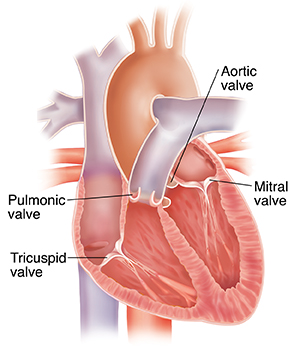
The heart has four valves. They are the aortic, pulmonary, tricuspid, and mitral valves. The valves open and close to keep blood moving in the right direction through the heart. Blood moves through the heart as it beats. With each squeeze, the valves open and close to keep blood moving forward. In this way, valves keep blood moving as well as possible through the heart. They also prevent backflow.
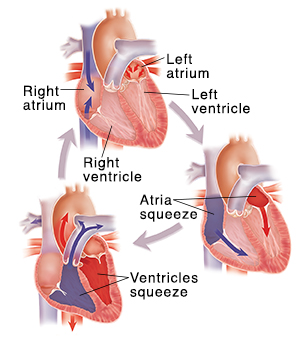
When the heart relaxes between beats:
-
Oxygen-rich blood from the lungs fills the left atrium.
-
Oxygen-poor blood from the body fills the right atrium.
When the atria beat:
-
The left atrium squeezes. This pushes blood through the mitral valve into the left ventricle.
-
The right atrium squeezes. This pushes blood through the tricuspid valve into the right ventricle.
When the ventricles beat:
-
The left ventricle squeezes. This pushes blood through the aortic valve out to the heart arteries, the brain, and body.
-
The right ventricle squeezes. This pushes blood through the pulmonary valve to the lungs.
Online Medical Reviewer: Glenn Gandelman MD MPH
Online Medical Reviewer: Lu Cunningham RN BSN
Date Last Reviewed: 08/01/2023
© 2000-2026 The StayWell Company, LLC. All rights reserved. This information is not intended as a substitute for professional medical care. Always follow your healthcare professional's instructions.
Need Help? We're Here for You
Our Member and Recipient Services Team is here to help you understand your benefits, find care, or resolve concerns.
800-510-9132
Call NC Quitline
Need support to quit smoking, vaping, or to quit other nicotine products? You can receive support including medicines free of charge:
800-784-8669
Schedule Transportation
Need transportation to a doctor's office, pharmacy, or other covered healthcare service? Contact us to arrange your ride.
800-510-9132
Provider Directory
Need to find a provider like a Primary Care Physician, Specialist, OB/GYN, or a Psychiatrist?
Provider DirectoryRelated Articles
What Is Cardiac Asthma?
Cardiac asthma can the same symptoms as true asthma. But the symptoms are caused by heart failure, which leads to fluid buildup in the lungs.
Unstable Angina
There are 2 types of angina, stable and unstable. Stable angina occurs at certain times and can often be managed. Unstable angina occurs at uncertain times. It may not get better with the usual forms of treatment for angina. It is a warning that a heart attack (acute myocardial infarction) is possible in the near future.
Emotional and Family Issues in Children With Heart Disease
A detailed look at the way children may feel about having congenital heart disease, plus some tips for helping them cope.
Heart Valve Problems: Aortic Stenosis
Aortic stenosis means your aortic valve has a problem opening. The left ventricle has to work harder to push the blood through the valve. In some cases, this extra work will make the muscle of the ventricle thicken. This type of stenosis can quickly get worse.


