This article applies to anyone with female anatomy. Please use this information in a way that works best for you and your health care provider as you talk about your care.
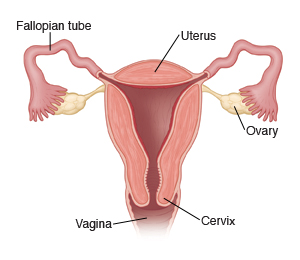
You have an infection called gonorrhea. It's a sexually transmitted infection (STI). It is very contagious. It is passed by sexual contact with an infected partner. Gonorrhea can infect the internal sex organs (cervix, uterus, or fallopian tubes). Less often, it can infect the mouth, throat, and anus. In rare cases, it can spread to infect the joints, eyes, and other parts of the body.
People with infections in the cervix may have no symptoms. Or they may have only mild symptoms early in the illness. So you can pass on this infection without knowing you have it.
When symptoms do occur, they often start 2 to 10 days after exposure. There may be a thick vaginal discharge and pain or burning when urinating. If the infection spreads to the fallopian tubes, it is called pelvic inflammatory disease (PID). This causes lower belly pain and fever. If not treated, gonorrhea can cause infertility (not able to have children) by scarring the fallopian tubes. PID also raises the risk of having a pregnancy outside the uterus (ectopic pregnancy) in the future.
Gonorrhea can be treated and cured. Treatment is with antibiotic medicine.
Home care
-
Any sexual partner you've had within the last 2 months needs to be treated, even if there are no symptoms. Your partner should reach out to their provider. Or they should go to an urgent care clinic or the public health department to be examined and treated.
-
Don't engage in sexual activity until both you and your partner have finished all antibiotic medicine. Also, wait until your provider tells you that you are no longer contagious.
-
Take all medicine as directed until it is gone. If not, the illness may come back.
-
Learn about “safer sex” practices and use them. The safest sex is with a partner who has tested negative and only has sex with you. Latex barriers, such as condoms, offer some protection from spreading of some STIs. These include gonorrhea, chlamydia, and HIV. But they are not a guarantee.
Follow-up care
Follow up with your provider, or as advised.
If tests were done, call as directed for results. A follow-up test should be done 4 to 6 weeks after treatment. It makes sure that the infection has cleared. Follow up with your provider or the public health department for full STI screening, including HIV testing.
When to contact your doctor
Call your provider or get medical care right away if:
-
There is no improvement after 3 days of treatment.
-
You have new or increasing lower belly or back pain.
-
You have unexpected vaginal bleeding.
-
You have repeated vomiting.
-
You are unable to pee due to pain.
-
You have rash or joint pain.
-
You have painful sores on the outer vaginal area.
-
You have enlarged, painful lymph nodes (lumps) in the groin.
-
You have a fever of 100.4ºF (38ºC) or higher, or as advised.
Call 911
Call 911 or get care right away if:
-
You feel weak.
-
You have dizziness.
-
You faint.
Online Medical Reviewer: Barry Zingman MD
Online Medical Reviewer: Donna Freeborn PhD CNM FNP
Online Medical Reviewer: L Renee Watson MSN RN
Date Last Reviewed: 02/01/2025
© 2000-2026 The StayWell Company, LLC. All rights reserved. This information is not intended as a substitute for professional medical care. Always follow your healthcare professional's instructions.
Need Help? We're Here for You
Our Member Services team is here to help you understand your benefits, find care, or resolve concerns.
1-800-510-9132
Call NC Quitline
Need support to quit smoking, vaping, or to quit other nicotine products? You can receive support including medicines free of charge:
1-800-784-8669
Schedule Transportation
Need transportation to a doctor's office, pharmacy, or other covered healthcare service? Contact us to arrange your ride.
1-800-510-9132
Provider Directory
Need to find a provider like a Primary Care Physician, Specialist, OB/GYN, or a Psychiatrist?
Provider DirectoryRelated Articles
Understanding Ehrlichiosis
Ehrlichiosis is an illness caused by the bacteria in a tick bite. Symptoms often show up 1 to 2 weeks after you are bitten.
Genital Warts
Learn how to care for yourself at home after you've been diagnosed with genital warts.
Understanding Valley Fever (Coccidioidomycosis)
Valley fever is an infection caused by a fungus that's breathed in from dust in the environment. It most often causes lung infection (pneumonia). Learn about symptoms, treatment, complications, and prevention.
Mononucleosis
Mononucleosis (also called mono) is a contagious viral infection. It's usually spread by contact with saliva, often by kissing.


