When air fills the space between your lung and chest wall (pleural cavity), it can cause all or part of your lung to collapse. The main cause of this is an injury to the chest cavity that punctures the lungs. Damage may result from a stab or gunshot wound, car accident, fall, or certain surgeries. In some cases, it happens without a clear cause (spontaneous).
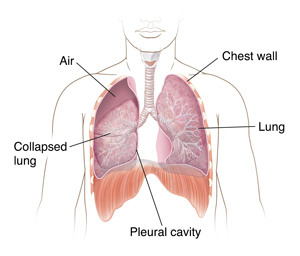
You're more likely to have spontaneous collapsed lung if you smoke or have a chronic lung disease, such as emphysema.
When to go to the emergency room (ER)
Serious collapsed lung can be fatal if not treated. Call
-
Sudden, sharp chest pain that may spread to your shoulder or back
-
Shortness of breath or trouble breathing
-
A bluish color to the skin
-
Loss of consciousness or feeling faint with any of the above symptoms
What to expect in the ER
-
You will be examined carefully.
-
Your lungs and heart will be listened to through a stethoscope.
-
You may have X-rays or a CT scan. A CT scan combines X-rays and computer scans to provide detailed pictures of your lungs.
-
You will be given help with breathing if you need it.
Treatment
-
If the collapsed lung is small, you may stay in the ER for 5 to 6 hours to see if it gets any worse. If it does not get worse, you may be sent home without treatment and told to follow up with your regular healthcare provider.
-
If the collapsed lung needs treatment, the provider may use a needle fit into the chest wall to suction extra air out of the pleural cavity. Or the provider may place a small catheter or a larger tube into your chest to better remove air from the pleural cavity. This is done at the bedside, and you will be given local anesthesia. If a larger tube is used, it is attached to a suction device that removes the air. Depending on the type of suction device, you may be able to return home to continue the suction and keep track of your condition there. Or you may be admitted to the hospital for a few days while the lung re-expands. If a small catheter was used to remove the air, it may be removed before you go home. If you are allowed to go home, you will be watched in the emergency room for 4 to 6 hours first to see if the collapsed lung gets worse during that time.
After treatment, you will be told what to do to care for yourself and when to follow up with your healthcare provider.
Online Medical Reviewer: Mary Mancini MD
Online Medical Reviewer: Ronald Karlin MD
Online Medical Reviewer: Stacey Wojcik MBA BSN RN
Date Last Reviewed: 09/01/2022
© 2000-2026 The StayWell Company, LLC. All rights reserved. This information is not intended as a substitute for professional medical care. Always follow your healthcare professional's instructions.
Need Help? We're Here for You
Our Member Services team is here to help you understand your benefits, find care, or resolve concerns.
1-800-510-9132
Call NC Quitline
Need support to quit smoking, vaping, or to quit other nicotine products? You can receive support including medicines free of charge:
1-800-784-8669
Schedule Transportation
Need transportation to a doctor's office, pharmacy, or other covered healthcare service? Contact us to arrange your ride.
1-800-510-9132
Provider Directory
Need to find a provider like a Primary Care Physician, Specialist, OB/GYN, or a Psychiatrist?
Provider DirectoryRelated Articles
What's Up with Sinusitis?
Millions of Americans are affected by sinusitis every year. But it's often misdiagnosed and misunderstood by people with the condition. Here's what you need to know.
Pharyngitis and Tonsillitis
Pharyngitis and tonsillitis are infections that cause inflammation. If the tonsils are mainly affected, it is called tonsillitis. If the throat is mainly affected, it is called pharyngitis. These infections are spread by close contact with others. Here's what you need to know.
Atelectasis
Atelectasis is the collapse of 1 or more sections (lobes) of the lungs. Here's what you need to know about this condition.
Interstitial Lung Disease (ILD)
Interstitial lung disease (ILD) is a group of conditions that cause inflammation and scarring around the tiny air sacs in the lungs. This makes it hard to take in oxygen.


