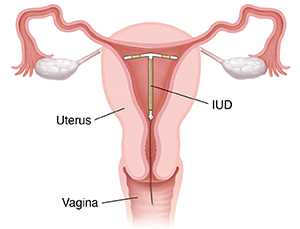
The IUD (intrauterine device) is small, flexible, and T-shaped. A trained doctor places it in the uterus. The IUD is one of the most effective birth control methods. It's also reversible. This means it can be removed at any time by a trained doctor. New IUDs are safer and don't have the same risks as older types of IUDs.
Pregnancy rates
Talk to your doctor about the effectiveness of this birth control method.
Types of IUDs
IUD insertion is done in the doctor’s office. Two types of IUDs are available:
-
The copper IUD releases a small amount of copper into the uterus. The copper makes it harder for sperm to reach the egg. The device works for about 10 years.
-
The progestin IUD releases a hormone called progestin. It causes changes in the uterus to help prevent pregnancy. The device works for 3 to 8 years, depending on which device is chosen. It may be recommended if you have anemia or heavy and painful periods.
IUDs have thin strings that hang from the opening of the uterus into the vagina. This lets you check that the IUD stays in place.
Things to know about IUDs
-
IUDs can be used if you have never been pregnant or if you have a history of sexually transmitted infections (STIs) or tubal pregnancy.
-
It won't move from the uterus to any other part of the body.
-
There is a slight risk of the device coming out of the vagina (expulsion).
-
It may not work if you have an abnormally shaped uterus.
-
A copper IUD may cause heavier periods and cramping.
-
A progestin IUD may cause light periods or no periods at all (irregular bleeding or spotting is possible and normal during the first 3 to 6 months).
-
If you get a sexually transmitted infection with an IUD in place, symptoms may be more severe.
What to report to your doctor
Be sure your doctor knows if you have:
-
A sexually transmitted infection (STI) or possible STI.
-
Liver problems.
-
Blood clots (for progestin IUD only).
-
Breast cancer or a history of breast cancer (progestin IUD only).
Featured in
Online Medical Reviewer: Donna Freeborn PhD CNM FNP
Online Medical Reviewer: Heather Trevino
Online Medical Reviewer: Irina Burd MD PhD
Date Last Reviewed: 07/01/2025
© 2000-2026 The StayWell Company, LLC. All rights reserved. This information is not intended as a substitute for professional medical care. Always follow your healthcare professional's instructions.
Need Help? We're Here for You
Our Member and Recipient Services Team is here to help you understand your benefits, find care, or resolve concerns.
800-510-9132
Call NC Quitline
Need support to quit smoking, vaping, or to quit other nicotine products? You can receive support including medicines free of charge:
800-784-8669
Schedule Transportation
Need transportation to a doctor's office, pharmacy, or other covered healthcare service? Contact us to arrange your ride.
800-510-9132
Provider Directory
Need to find a provider like a Primary Care Physician, Specialist, OB/GYN, or a Psychiatrist?
Provider DirectoryRelated Articles
The Range of Pap Test Results
When your Pap test is sent to the lab, the lab studies your cell samples and reports any abnormal cell changes. Your healthcare provider can discuss these changes with you. In some cases, an abnormal Pap test is due to an infection.
How Birth Control Works
Birth control prevents pregnancy by preventing conception. Some methods prevent an egg from maturing. Some keep the sperm and egg from meeting. And some methods work in both ways.
Birth Control: Diaphragm and Cervical Cap
The diaphragm and the cervical cap are cup-shaped devices that are inserted into the vagina. They protect against pregnancy by covering the cervix and keeping sperm from meeting the egg.
Vaginal Infection: Understanding the Vaginal Environment
A normal healthy vaginal environment has bacteria and other organisms. If this becomes out of balance, infection can result.


