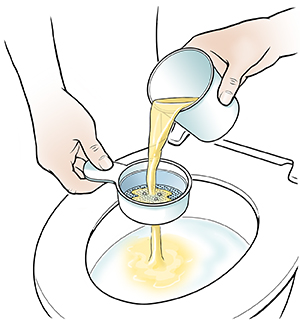
There are four general types of kidney stones. Your kidney stone’s size and shape determine whether it's likely to pass by itself. Knowing what a stone is made of (its composition) helps your health care provider find its cause and prescribe the best treatment. X-rays or scans can help show the stone's size and shape. Your provider may also give you a strainer to catch the stone while passing urine. The stone can then be sent to a lab for analysis. You may need other types of urine and blood tests to help identify the stone. These tests can also help find causes for different types of stones.
The tests can show:
-
Size. A stone may be as small as a grain of sand. Some may be the size of a pebble. A few may be as large as a golf ball. Small stones may pass out of your body when you urinate.
-
Shape. Small, smooth, round stones may pass easily. Jagged-edged stones often lodge inside the kidney or ureter. Staghorn stones can fill the entire renal pelvis and calyces.
-
Composition. Most stones are made of calcium oxalate, a hard compound. Stones made of uric acid or cystine or that are caused by infection (struvite stones), are less dense. Stones often contain more than one chemical.
Treating your stones
You and your health care provider will work together to form a treatment plan. Your provider may suggest that you let your stone pass naturally. Or you may choose to manage it with medicines. Certain procedures may also help, such as shock wave lithotripsy or using a thin tube with a camera inside the body to remove the stone (ureteroscopy). When they find out the cause of the stone, you will be told how you can help prevent kidney stones in the future.
Featured in
Online Medical Reviewer: Daphne Pierce-Smith RN MSN
Online Medical Reviewer: Lalitha Kadali
Online Medical Reviewer: Melinda Murray Ratini DO
Date Last Reviewed: 04/01/2025
© 2000-2026 The StayWell Company, LLC. All rights reserved. This information is not intended as a substitute for professional medical care. Always follow your healthcare professional's instructions.
Need Help? We're Here for You
Our Member and Recipient Services Team is here to help you understand your benefits, find care, or resolve concerns.
800-510-9132
Call NC Quitline
Need support to quit smoking, vaping, or to quit other nicotine products? You can receive support including medicines free of charge:
800-784-8669
Schedule Transportation
Need transportation to a doctor's office, pharmacy, or other covered healthcare service? Contact us to arrange your ride.
800-510-9132
Provider Directory
Need to find a provider like a Primary Care Physician, Specialist, OB/GYN, or a Psychiatrist?
Provider DirectoryRelated Articles
Hemodialysis Access Bleeding
You have a hemodialysis access in your arm, either an arteriovenous (AV) fistula or an artery to vein graft. It has been bleeding. Blood needs to flow freely through the fistula or graft. As part of your treatment, you are also taking medication that thins your blood. This makes you bleed more easily. It is important to stop your fistula or graft from bleeding as soon as possible.
The Craniofacial Team
Read this for information about a first assessment of any craniofacial abnormalities your child may have and the craniofacial treatment team that will treat them.
Discharge Instructions for Kidney Biopsy
Your doctor used a special needle to remove a small piece of tissue from your kidney to examine it for signs of damage and disease. A kidney biopsy is ordered after other tests have shown that there may be a problem with your kidney. Kidney biopsies are also performed when kidney disease is suspected and to rule out cancer.
Shock Wave Lithotripsy
Shock wave lithotripsy is a treatment that breaks a kidney stone into smaller pieces that are easier to pass. This treatment is also called extracorporeal shock wave lithotripsy (ESWL).


