Pelvic ultrasound is an imaging test that uses sound waves to form pictures of your organs. It can help assess pain or other symptoms within your pelvis, the area between your hip bones. In women who are not pregnant, it is typically done to check the uterus and ovaries. In pregnant women, it is used to check the health of the unborn baby. There are no known risks of diagnostic ultrasound.
How do I get ready for an ultrasound?
-
You may be told to drink several glasses of water or other clear fluid starting 1 to 2 hours before your test. Ask your health care provider for specific instructions.
-
The test may take 30 to 45 minutes. Allow extra time to check in.
Important
The health care professional doing the ultrasound may ask why your provider has ordered the test. They may also ask when your last period started. Also let them know:
-
If you’ve had an ultrasound exam of this area before.
-
If you’ve had any pelvic surgery.
-
What medicines you take.
-
If you’re pregnant.
What happens during the ultrasound?
-
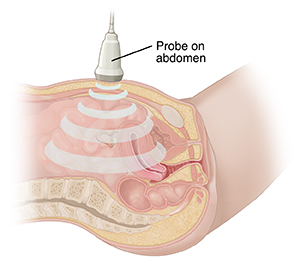
You will lie on your back with your belly (abdomen) exposed.
-
A nongreasy gel will be applied to the skin.
-
The sonographer will move a handheld probe (transducer) across your pelvis.
The test may include a second part. You can empty your bladder before this part of the test.
-
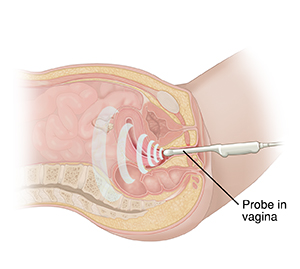
You will lie on your back with your knees raised.
-
A probe covered with nongreasy gel is placed inside your vagina. Or you may be asked to insert the probe yourself as you would a tampon. The probe should not be painful.
What happens after an ultrasound?
-
Your health care provider will discuss the test results with you during a follow-up visit or over the phone.
-
Your next appointment is: ____________________
Featured in
Online Medical Reviewer: Daphne Pierce-Smith RN MSN
Online Medical Reviewer: Rajadurai Samnishanth Researcher
Online Medical Reviewer: Raymond Turley Jr PA-C
Date Last Reviewed: 02/01/2025
© 2000-2026 The StayWell Company, LLC. All rights reserved. This information is not intended as a substitute for professional medical care. Always follow your healthcare professional's instructions.
Need Help? We're Here for You
Our Member and Recipient Services Team is here to help you understand your benefits, find care, or resolve concerns.
800-510-9132
Call NC Quitline
Need support to quit smoking, vaping, or to quit other nicotine products? You can receive support including medicines free of charge:
800-784-8669
Schedule Transportation
Need transportation to a doctor's office, pharmacy, or other covered healthcare service? Contact us to arrange your ride.
800-510-9132
Provider Directory
Need to find a provider like a Primary Care Physician, Specialist, OB/GYN, or a Psychiatrist?
Provider DirectoryRelated Articles
Urethral Stricture
Narrowing or blockage of the urethra is known as a urethral stricture. This is more common in men than in women.
Understanding Changes in Your Cervix
Cells in the cervix are always changing. In some cases, these cells can change to become abnormal. This is called dysplasia. Dysplasia can turn into cancer. But with regular Pap tests, dysplasia can be caught and treated early.
Cervical Biopsy
A cervical biopsy is a procedure to remove tissue from the cervix to test for abnormal or precancerous conditions, or cervical cancer.
Female Reproductive Anatomy
Your body has a special system built to create and support a growing baby. This is called your reproductive anatomy. Get to know the parts of your body and what they do.


