Fallopian tube catheterization helps open a blocked fallopian tube. It improves your chances of getting pregnant. The fallopian tubes carry eggs from your ovaries to your uterus (womb). When sperm meets an egg in a fallopian tube, the egg is fertilized. But if the tubes are blocked, that can’t happen. This procedure is done by a healthcare provider called an interventional radiologist.
Getting ready for your procedure
-
The procedure is done a short time after your menstrual period ends. This helps make sure you are not pregnant. If you can't recall the date of your last period, you may be asked to reschedule.
-
You may be given antibiotics to take before and after the procedure. Take them as directed to lower the risk for infection.
-
You may be given pain medicine to take before your procedure. Take it as directed.
-
Ask a responsible adult family member or friend to give you a ride home after your procedure. You won't be able to drive.
-
Follow any other instructions your provider gives you to get ready.
During your procedure
Your healthcare provider will go over the procedure with you. In general, here's what you can expect:
-
You will lie on your back on an X-ray table.
-
An IV (intravenous) line may be put into a vein in your arm or hand. This line gives you medicines (anesthesia) to help relax you and keep you from feeling pain.
-
A small metal or plastic tube (speculum) is put into your vagina to hold it open.
-
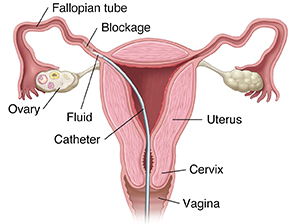
A thin, flexible tube (catheter) is put through your cervix into your uterus.
-
X-ray dye (contrast medium) is put into the catheter. It flows up into your fallopian tubes. The dye helps your provider see your tubes more clearly on the X-ray images. This test is called a hysterosalpingogram. It will show any blockage that may be in your fallopian tube. It helps guide the rest of the procedure.
-
The catheter is moved into your fallopian tube.
-
Fluid is injected through the catheter into the fallopian tube. This helps to clear the blockage. The catheter may have a small balloon or wire on the end. The balloon can be inflated to help clear the blockage. The wire can also be passed to help clear the blockage.
After your procedure
-
Some cramping and mild bleeding is common for 3 to 5 days.
-
Don’t put anything into your vagina for 48 hours after your procedure. Don't use tampons or have sex during that time.
Call your healthcare provider if you have any of these:
-
Severe pain or cramps
-
Bleeding other than mild spotting
-
Vaginal discharge
-
Fever over 100.4°F (38°C), or as directed
Schedule a check-up visit with your healthcare provider, or as directed.
Risks and possible complications
All procedures have some risk. Possible risks of fallopian tube catheterization are:
-
Small hole (perforation) in a fallopian tube
-
Pelvic infection
-
Problems from the X-ray dye, such as an allergic reaction or kidney damage
-
Tubal pregnancy when a fertilized egg stays and grows in a fallopian tube
-
Radiation exposure to your reproductive organs, but the risk from this is low
-
Fallopian tubes that get blocked again, which may call for another procedure
Online Medical Reviewer: Deepak Sudheendra MD
Online Medical Reviewer: Louise Cunningham RN BSN
Online Medical Reviewer: Raymond Turley Jr PA-C
Date Last Reviewed: 10/01/2024
© 2000-2026 The StayWell Company, LLC. All rights reserved. This information is not intended as a substitute for professional medical care. Always follow your healthcare professional's instructions.
Need Help? We're Here for You
Our Member Services team is here to help you understand your benefits, find care, or resolve concerns.
1-800-510-9132
Call NC Quitline
Need support to quit smoking, vaping, or to quit other nicotine products? You can receive support including medicines free of charge:
1-800-784-8669
Schedule Transportation
Need transportation to a doctor's office, pharmacy, or other covered healthcare service? Contact us to arrange your ride.
1-800-510-9132
Provider Directory
Need to find a provider like a Primary Care Physician, Specialist, OB/GYN, or a Psychiatrist?
Provider DirectoryRelated Articles
Uterine Fibroid Embolization
Fibroids are noncancerous growths of muscle tissue on or inside the uterus. Uterine fibroid embolization shrinks a fibroid by cutting off its blood supply.
Hormonal Therapy: Managing Side Effects in Women
The female hormones estrogen and progesterone promote the growth of some breast tumors. Hormonal therapy may be given to block these hormones from stimulating tumor growth.
For Women: Deciding About Hormone Therapy (HT)
Is HT right for you? That's up to you and your health care provider. Your health care provider will review your health needs. Then they will suggest steps you can take to control any symptoms or health risks. HT may be one part of your overall program.
Improving Your Fertility
Your healthcare provider may suggest some simple methods to help you get pregnant. Most focus on predicting ovulation. This is the time when sex has the best chance of success. Your healthcare provider may also advise working on other factors that can affect fertility.