Vaginal vault prolapse is when the vagina loses its support and drops toward the opening. Sometimes it drops beyond the opening. This can happen after the uterus has been removed. Surgery is done to fix the problem and ease your symptoms.
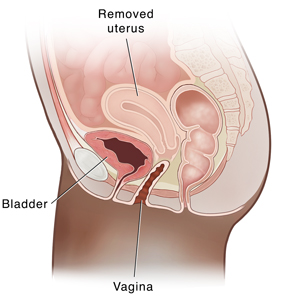
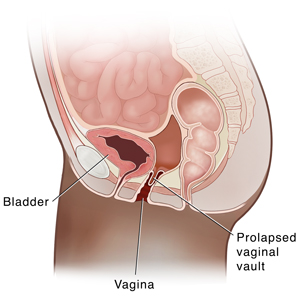
The surgical procedure
A vaginal vault suspension may be done. This type of surgery can be done through the vagina or the belly (abdomen). The vagina is attached to strong tissue in the pelvis or to the sacrum. This is a bone at the base of the spine that forms the back of the pelvis.
Possible risks and complications of surgery
-
Infection
-
Bleeding
-
Risks of anesthesia
-
Damage to nerves, muscles, or nearby pelvic structures
-
Blood clots
-
Prolapse occurring again
Your incisions
During surgery, the surgeon reaches your pelvic organs through the vagina or the belly. A cut (incision) may be made in the vaginal wall. If surgery through the belly is done, the surgeon makes a few small cuts to insert tiny laparoscopic tools. Or the surgeon makes one larger cut. This larger cut can be up and down (vertical) or across (transverse).
Featured in
Online Medical Reviewer: Daphne Pierce-Smith RN MSN
Online Medical Reviewer: Rajadurai Samnishanth Researcher
Online Medical Reviewer: Raymond Turley Jr PA-C
Date Last Reviewed: 02/01/2025
© 2000-2026 The StayWell Company, LLC. All rights reserved. This information is not intended as a substitute for professional medical care. Always follow your healthcare professional's instructions.
Need Help? We're Here for You
Our Member and Recipient Services Team is here to help you understand your benefits, find care, or resolve concerns.
800-510-9132
Call NC Quitline
Need support to quit smoking, vaping, or to quit other nicotine products? You can receive support including medicines free of charge:
800-784-8669
Schedule Transportation
Need transportation to a doctor's office, pharmacy, or other covered healthcare service? Contact us to arrange your ride.
800-510-9132
Provider Directory
Need to find a provider like a Primary Care Physician, Specialist, OB/GYN, or a Psychiatrist?
Provider DirectoryRelated Articles
Understanding Robotic-Assisted Sacrocolpopexy (RASC)
Robotic-assisted sacrocolpopexy is a type of surgery. It's done to repair pelvic organ prolapse. The surgery is done with special tools and a robotic controller.
Stress Urinary Incontinence: Having Pubovaginal Sling Surgery
To help treat stress urinary incontinence (SUI), your surgeon may do a procedure called pubovaginal sling surgery. Read on to learn what to expect before, during, and after the surgery.
Stress Urinary Incontinence: Having Retropubic Suspension Surgery
Retropubic suspension is a type of surgery to treat stress urinary incontinence. Read on for helpful details about the surgery and what to expect.
Pelvic Organ Prolapse: Surgery for Cystocele
Cystocele is when the bladder sags into the vagina. The goal of surgery is to repair the problem and relieve symptoms.


