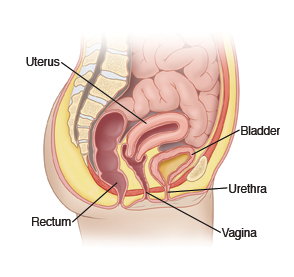
Any object placed inside the vagina is called a vaginal foreign body. This includes tampons, birth control devices, and sex toys. In some cases, objects not designed for the vagina may be placed inside.
If an object is left inside the vagina too long or becomes stuck, it can cause symptoms. It can also lead to infection and damage nearby tissues.
Symptoms can include abnormal or bad-smelling discharge. Bleeding, redness, swelling, or rash may also occur. Some women may feel pain or pressure in or around the vagina.
Treatment includes removing the object. Once the object is removed, symptoms should go away. If the object caused an infection, antibiotics may be given.
Home care
-
If you’re prescribed any medicines, take them as directed.
-
Don’t douche unless advised to by your healthcare provider.
-
Wait until all symptoms are gone before having sex.
-
Check with your provider before using tampons. If it’s OK, remember to remove each tampon you use after 6 to 8 hours or sooner.
-
If you have new symptoms or any questions or concerns, contact your healthcare provider.
Follow-up care
Follow up with your healthcare provider, or as advised.
When to get medical advice
Call your healthcare provider right away if any of the following occur:
-
Your symptoms don’t improve, or they get worse.
-
You develop pain in the belly or groin, especially if it gets worse with walking.
-
You have burning or pain when urinating.
-
You have a fever of 100.4ºF (38ºC) or higher, or as directed by your healthcare provider.
Call 911
Call 911 or get medical care right away if you:
-
Feel weak, dizzy, or faint.
-
Have an unusually large amount of bleeding from your vagina
Featured in
Online Medical Reviewer: Eric Perez MD
Online Medical Reviewer: Ronald Karlin MD
Online Medical Reviewer: Tara Novick BSN MSN
Date Last Reviewed: 12/01/2022
© 2000-2026 The StayWell Company, LLC. All rights reserved. This information is not intended as a substitute for professional medical care. Always follow your healthcare professional's instructions.
Need Help? We're Here for You
Our Member and Recipient Services Team is here to help you understand your benefits, find care, or resolve concerns.
800-510-9132
Call NC Quitline
Need support to quit smoking, vaping, or to quit other nicotine products? You can receive support including medicines free of charge:
800-784-8669
Schedule Transportation
Need transportation to a doctor's office, pharmacy, or other covered healthcare service? Contact us to arrange your ride.
800-510-9132
Provider Directory
Need to find a provider like a Primary Care Physician, Specialist, OB/GYN, or a Psychiatrist?
Provider DirectoryRelated Articles
Thinking About Hysterectomy
Before advising a hysterectomy, your healthcare provider will evaluate your health problem. You and your healthcare provider will go over the results of your exams and tests. Together, you can discuss your choices and make a treatment plan.
Hysterosalpingogram (HSG)
HSG is an X-ray test used to view your uterus and fallopian tubes. It's most often used to help diagnose why you are not able to get pregnant.
Having Robotic-Assisted Myomectomy
Robotic-assisted myomectomy is a type of surgery. It's done to remove growths in a women's womb (uterus) called fibroid tumors. The tumors are not cancer. The surgery is done with special tools and a robotic controller.
Colposcopy
Colposcopy is a procedure that gives your health care provider a magnified view of the cervix. It is done using a lighted microscope called a colposcope. In most cases, a sample of cervical cells is taken during a biopsy.


