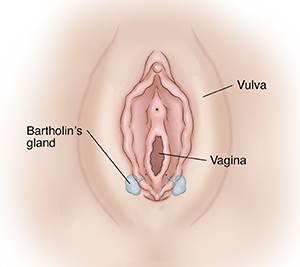
A woman has two Bartholin glands. They are located on the sides of the vaginal opening. These pea-sized glands make mucus. The mucus lubricates the outside part of the vagina (vulva). If a tube (duct) in one of these glands becomes blocked, it can cause a cyst or abscess.
What causes a Bartholin cyst or abscess?
A cyst can form when the duct of a Bartholin gland becomes blocked. The mucus can’t come out of the gland. It builds up. If the cyst becomes infected, it may turn into an abscess.
A blockage in the gland can occur from an injury or an infection, such as a sexually transmitted infection (STI).
Symptoms of a Bartholin cyst or abscess
A Bartholin cyst starts as a small bump. It may cause no other symptoms. Or it may grow bigger. It can then cause swelling and pain. If an abscess forms, it can be very painful. You may have a fever. You may have trouble walking, sitting, or having sex.
Treatment for a Bartholin cyst or abscess
A cyst that doesn’t cause any symptoms may not need to be treated. It may go away on its own. But if you feel discomfort or pain, treatment options include:
-
Medicine. Over-the-counter pain medicines can help. In some cases, you may need antibiotics if an infection is severe, or a cyst or abscess comes back. If your doctor prescribes antibiotics, take them as directed. Do not stop taking them just because you feel better. You need to take the full course of antibiotics.
-
Sitz bath. Soaking the genital area in warm water can ease pain and sometimes help the cyst to drain on its own.
-
Drainage. Cutting open the cyst allows the fluid inside it to drain. This eases discomfort and pain. The doctor may insert a tube (catheter) to help with drainage. The catheter may need to stay in place for up to 3 weeks.
-
Surgery. You may need to have the Bartholin glands removed if other treatments don’t work.
When to contact your doctor
Call your doctor right away if:
-
You have a fever of 100.4°F (38°C) or higher, or as directed by your doctor.
-
You have redness, swelling, or fluid leaking from the cyst that gets worse.
-
Your pain gets worse.
-
Your symptoms don’t get better, or get worse.
-
You have new symptoms.
Featured in
Author: Semko, Laura
Online Medical Reviewer: Donna Freeborn PhD CNM FNP
Online Medical Reviewer: Heather M Trevino BSN RNC
Online Medical Reviewer: Irina Burd MD PhD
Date Last Reviewed: 07/01/2025
© 2000-2026 The StayWell Company, LLC. All rights reserved. This information is not intended as a substitute for professional medical care. Always follow your healthcare professional's instructions.
Need Help? We're Here for You
Our Member Services team is here to help you understand your benefits, find care, or resolve concerns.
1-800-510-9132
Call NC Quitline
Need support to quit smoking, vaping, or to quit other nicotine products? You can receive support including medicines free of charge:
1-800-784-8669
Schedule Transportation
Need transportation to a doctor's office, pharmacy, or other covered healthcare service? Contact us to arrange your ride.
1-800-510-9132
Provider Directory
Need to find a provider like a Primary Care Physician, Specialist, OB/GYN, or a Psychiatrist?
Provider DirectoryRelated Articles
Cervicitis
Cervicitis is irritation or infection of the cervix. It can be caused by a number of different sexually transmitted diseases.
Uterine Fibroids
Fibroids are lumps of muscle tissue. They can form in the wall of uterus. They are almost always benign. It is not known what causes them.
Endometriosis
The tissue that lines the uterus is called the endometrium. Normally, if a woman doesn’t get pregnant, this tissue is shed each month during her period. In endometriosis, tissue that looks and acts like endometrial tissue implants outside the uterus.This can cause pain, heavy periods, and infertility.
Painful Periods (Dysmenorrhea)
Painful periods cause severe cramps and pain during a woman's period. It can start with your first period, or begin later in life. It can be related to an underlying condition, such as endometriosis.


