Corns and calluses are your body’s response to friction or pressure against the skin. If your foot rubs the inside of your shoe, the affected area of skin gets thick. Or if a bone is not in the normal position, skin caught between bone and shoe or bone and ground builds up. In either case, the outer layer of skin gets thick to protect the foot from unusual pressure. In many cases, corns and calluses look bad but are not harmful. But more severe corns and calluses may hurt, become infected, destroy healthy tissue, or affect foot movement.
Corns
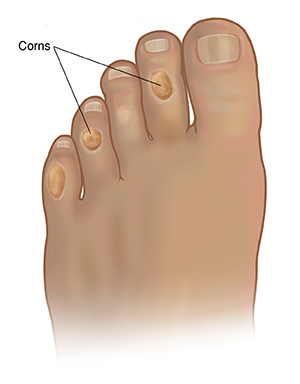
Corns are formed when the skin gets thick with a center core. They can be a painful soft or hard bump. Corns usually grow on top of the foot, often at the toe joint. They often form on top of buckled toe joints (hammer toes). If your toes curl under, corns may grow on the tips of the toes. You may also get a corn on the end of a toe if it rubs against your shoe. Corns can also grow between toes, often between the first and second toes.
Calluses
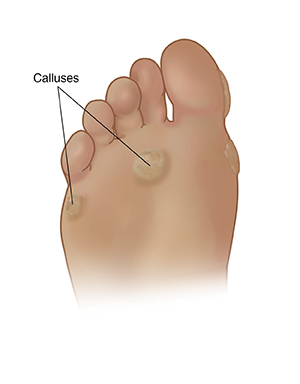
Calluses are a flat, widespread area of the outer layer of skin that gets thick. Calluses can occur on feet and hands. Calluses on the hands may develop from playing a musical instrument or working with your hands. This might be in carpentry or with mechanical equipment. Calluses grow on the bottom of the foot or on the outer edge of a toe or heel. A callus may spread across the ball of your foot. This type of callus is usually from a problem with the long bone at the base of a toe, near the ball of the foot (metatarsal). A pinch callus may grow along the outer edge of the heel or the big toe. Some calluses press up into the foot instead of spreading on the outside. A callus may form a central core or plug of tissue where pressure is greatest.
Online Medical Reviewer: Louise Cunningham RN BSN
Online Medical Reviewer: Raymond Turley Jr PA-C
Online Medical Reviewer: Thomas N Joseph MD
Date Last Reviewed: 09/01/2025
© 2000-2026 The StayWell Company, LLC. All rights reserved. This information is not intended as a substitute for professional medical care. Always follow your healthcare professional's instructions.
Need Help? We're Here for You
Our Member and Recipient Services Team is here to help you understand your benefits, find care, or resolve concerns.
800-510-9132
Call NC Quitline
Need support to quit smoking, vaping, or to quit other nicotine products? You can receive support including medicines free of charge:
800-784-8669
Schedule Transportation
Need transportation to a doctor's office, pharmacy, or other covered healthcare service? Contact us to arrange your ride.
800-510-9132
Provider Directory
Need to find a provider like a Primary Care Physician, Specialist, OB/GYN, or a Psychiatrist?
Provider DirectoryRelated Articles
The Kneecap (Patella) in Action
As the leg moves, the kneecap moves, too. It slides up and down its track on the thighbone. But if the kneecap slides “off track”—even a little—pain and damage can result.
Anatomy of the Spine
Your backbone, also called the vertebral column, is made up of 33 vertebrae separated by spongy disks.
What Are Mallet, Hammer, and Claw Toes?
Mallet, hammer, and claw toes are among the most common foot problems. They are often caused by wearing shoes that are too short or heels that are too high.
The Shoulder Joint
The shoulder is made up of bones, muscles, ligaments, and tendons. Learning about the parts of the shoulder joint will help you to understand your shoulder problem.