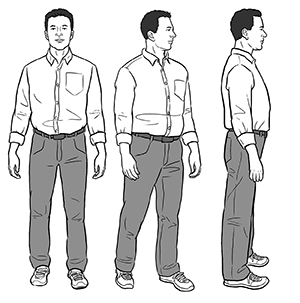
Protect your back while you stand or turn. Turning can twist your spine if you don’t do it correctly. Keep these tips in mind as you move.
Step 1
-
To turn, move your feet instead of twisting your body at the waist.
-
Turn your hips and shoulders together.
Step 2
-
Take short steps around.
-
Try pivoting on the heel closest to where you’re headed.
Step 3
-
Step forward out of the turn.
-
Keep your knees relaxed and your stomach muscles tightened.
Online Medical Reviewer: Kenny Turley PA-C
Online Medical Reviewer: L Renee Watson MSN RN
Online Medical Reviewer: Thomas N Joseph MD
Date Last Reviewed: 08/01/2022
© 2000-2026 The StayWell Company, LLC. All rights reserved. This information is not intended as a substitute for professional medical care. Always follow your healthcare professional's instructions.
Need Help? We're Here for You
Our Member and Recipient Services Team is here to help you understand your benefits, find care, or resolve concerns.
800-510-9132
Call NC Quitline
Need support to quit smoking, vaping, or to quit other nicotine products? You can receive support including medicines free of charge:
800-784-8669
Schedule Transportation
Need transportation to a doctor's office, pharmacy, or other covered healthcare service? Contact us to arrange your ride.
800-510-9132
Provider Directory
Need to find a provider like a Primary Care Physician, Specialist, OB/GYN, or a Psychiatrist?
Provider DirectoryRelated Articles
Plaster Splint Care
Here are directions to care for your splint at home.
Back Safety: Sitting
Sitting can strain your back if you don't do it right. Learn the right moves to protect your back.
Wearing a Rib Belt
A rib belt is an elastic strap that may help reduce pain from chest muscle strain or rib fracture.
Sling
A sling is designed to support your arm in a position of rest. It is used for injuries of the hand, forearm, upper arm, and shoulder.


