Using the bathroom can be challenging after hip surgery. Follow your “hip precautions” and the tips on this sheet to keep your new hip safe when using the toilet.
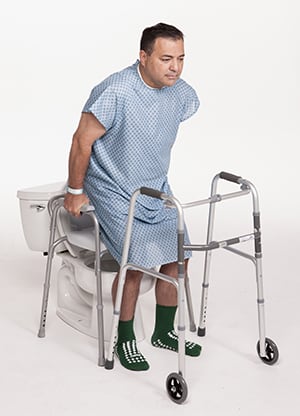
- Back up until you feel the toilet touch the back of your legs.
- Place your operated leg in front of you, keeping your weight on the other leg.
- Look behind you and grasp the grab bar (or side rails, if you're using a toilet with rails).
- Lower yourself onto the front of the toilet, then scoot back.
- To get up, reverse these steps.
- If you have a low toilet seat at home, your doctor may prescribe an elevated toilet seat lift.
Remember your hip precautions
- Don't bend your hip at the waist more than 90°. (Don't move your knees and chest too far toward each other.)
- Don't cross your legs or ankles or let your operated thigh cross the middle of your body.
- Don't turn your operated hip or knee inward.
Online Medical Reviewer: L Renee Watson MSN RN
Online Medical Reviewer: Raymond Turley Jr PA-C
Online Medical Reviewer: Thomas N Joseph MD
Date Last Reviewed: 07/01/2023
© 2000-2026 The StayWell Company, LLC. All rights reserved. This information is not intended as a substitute for professional medical care. Always follow your healthcare professional's instructions.
Need Help? We're Here for You
Our Member Services team is here to help you understand your benefits, find care, or resolve concerns.
1-800-510-9132
Call NC Quitline
Need support to quit smoking, vaping, or to quit other nicotine products? You can receive support including medicines free of charge:
1-800-784-8669
Schedule Transportation
Need transportation to a doctor's office, pharmacy, or other covered healthcare service? Contact us to arrange your ride.
1-800-510-9132
Provider Directory
Need to find a provider like a Primary Care Physician, Specialist, OB/GYN, or a Psychiatrist?
Provider DirectoryRelated Articles
Back Safety: Bending
Here are tips on how to move safely and protect your back when you need to bend.
Back Safety: Pushing and Pulling
Pushing can be hard on your back, but pulling can be even harder. So, push rather than pull when you can.
Conditioning Before Knee Replacement
Conditioning your body BEFORE knee replacement can help speed your recovery. Daily exercise helps strengthen muscles that support the knee joint.
Knee Immobilizer
A knee immobilizer is a type of brace used to provide support and limit movement of the knee. Here's what you need to know as you heal at home.


