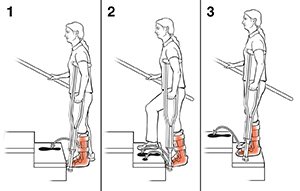
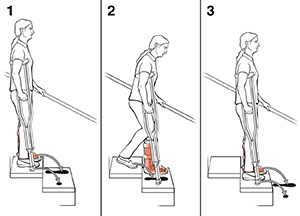
When climbing up and down steps, remember this rule: Up with the good (unaffected leg) and down with the bad (affected leg). Note: If you’re supposed to keep all weight off your leg (non-weight-bearing), ask your health care provider for special instructions.
Tip
Ask a friend to carry one of your crutches while you go up or down stairs.
Take care when using stairs
-
Always use an elevator if available.
-
Have someone guard you as you learn to use stairs. A guard stands below you. They hold your belt (or a special "gait belt" you can borrow or buy) to help you if you lose your balance.
-
When there is no handrail, keep one crutch under each arm.
-
If the stairs are slippery or steep, it may be safer to lift or lower yourself from step to step while sitting. Hold both your crutches in one hand as you do so.
Going up stairs
Follow these instructions so that your weight is supported either by the crutches and the handrail or by the crutches and your stronger leg.
-
Hold the handrail with the hand on the unaffected side.
-
If a friend is not available to carry one of the crutches, tuck both crutches under your armpit on the affected side. Put both crutches in your other hand.
-
Support your weight evenly between the handrail and your crutches.
-
Put some weight on the crutches.
-
Step up with your unaffected foot.
-
Get your balance.
-
Straighten your unaffected knee and lift your body weight.
-
Bring your crutches and affected leg up.
-
If there is no handrail:
-
Hold one crutch in each hand.
-
Move your affected leg and the crutches together as a single unit.
-
Let your strong leg do the work to climb the stairs.
Going down stairs
-
Hold the handrail with the hand on your unaffected side.
-
If a friend is not available to carry one of the crutches, put both crutches in your other hand.
-
Bend your unaffected knee, moving your crutches and affected leg down.
-
Support your weight evenly between the handrail and your crutches.
-
Slowly bring your unaffected leg down.
-
Don’t hop.
Safety tips
-
Wear shoes that do not slip off. Avoid slippers, shoes with leather soles, heels, and flip-flops.
-
Wear shoes or slippers with rubber or non-skid soles.
-
Always watch out for slippery walking surfaces.
-
Check the tip or tips of your crutches daily and replace them if they are worn.
Online Medical Reviewer: Marianne Fraser MSN RN
Online Medical Reviewer: Trina Bellendir PT
Online Medical Reviewer: Vinita Wadhawan Researcher
Date Last Reviewed: 12/01/2024
© 2000-2026 The StayWell Company, LLC. All rights reserved. This information is not intended as a substitute for professional medical care. Always follow your healthcare professional's instructions.
Need Help? We're Here for You
Our Member and Recipient Services Team is here to help you understand your benefits, find care, or resolve concerns.
800-510-9132
Call NC Quitline
Need support to quit smoking, vaping, or to quit other nicotine products? You can receive support including medicines free of charge:
800-784-8669
Schedule Transportation
Need transportation to a doctor's office, pharmacy, or other covered healthcare service? Contact us to arrange your ride.
800-510-9132
Provider Directory
Need to find a provider like a Primary Care Physician, Specialist, OB/GYN, or a Psychiatrist?
Provider DirectoryRelated Articles
Fitting Your Walker
Learn how to use your walker safely.
Back Safety: Pushing and Pulling
Pushing can be hard on your back, but pulling can be even harder. So, push rather than pull when you can.
Self-Care for Strains and Sprains
Most minor strains and sprains can be treated with self-care. But if you have torn tissue or damaged blood vessels, nerves, or bones, be sure to call your healthcare provider.
Knee Immobilizer
A knee immobilizer is a type of brace used to provide support and limit movement of the knee. Here's what you need to know as you heal at home.


