Following your healthcare provider's instructions after knee replacement helps with early recovery. Once you can stand, you’ll start using a walker. Use the walker for moving around as long as the provider asks you to. This is generally four to six weeks but may vary from person to person. There are three main types of walkers:
-
Standard without wheels
-
2-wheeled (front) rolling walker
-
4-wheeled rolling walker
Your physical therapist or another member of your healthcare team will help you select the best walker for you. As you become better at using the walker and your knee strengthens, you’ll be taught more advanced skills. For instance, after your physical or occupational therapist or physiatrist has shown you the correct procedures, you may practice stepping on and off a curb as directed.
Your first steps
-
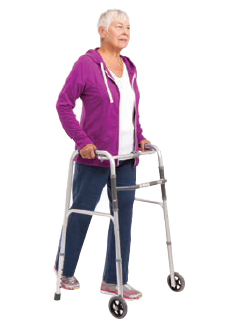
Push your walker a few inches in front of you.
-
Keeping your back straight, lean on the walker so it supports your weight. Step into the center of the walker with your operated leg, being careful not to twist your leg. Then, step with your other leg.
-
As you get more comfortable using the walker, you may be able to move it as you step.
Walking up a curb
-
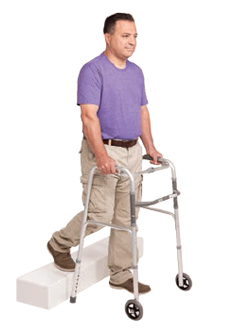
Move your feet and the walker as close to the curb as possible.
-
Put your weight on both your legs, then lift the walker onto the curb.
-
Step up with the un-operated leg. Using the walker to support your weight, bring up the operated leg.
Walking down a curb
-
Move your feet and the walker as close to the edge of the curb as you safely can.
-
Lower the walker onto the ground, keeping its back legs against the curb.
-
Using the walker to support your weight, lower the operated leg. Then step down with the other leg.
Online Medical Reviewer: Shaziya Allarakha MD
Online Medical Reviewer: Stacey Wojcik MBA BSN RN
Online Medical Reviewer: Trina Bellendir PT
Date Last Reviewed: 08/01/2024
© 2000-2026 The StayWell Company, LLC. All rights reserved. This information is not intended as a substitute for professional medical care. Always follow your healthcare professional's instructions.
Need Help? We're Here for You
Our Member and Recipient Services Team is here to help you understand your benefits, find care, or resolve concerns.
800-510-9132
Call NC Quitline
Need support to quit smoking, vaping, or to quit other nicotine products? You can receive support including medicines free of charge:
800-784-8669
Schedule Transportation
Need transportation to a doctor's office, pharmacy, or other covered healthcare service? Contact us to arrange your ride.
800-510-9132
Provider Directory
Need to find a provider like a Primary Care Physician, Specialist, OB/GYN, or a Psychiatrist?
Provider DirectoryRelated Articles
Understanding Leg Amputation: Surgery After Injury
Amputation is a surgery to remove part or all of your leg. It's done because tissue in the leg is damaged and can't be healed. Read on to learn about the procedure, and what to expect afterward.
Home Safety After Joint Surgery
Follow these tips for home safety after joint surgery.
After Knee Replacement: Managing Pain at Home
After knee replacement surgery, it's important to use pain medicine as directed to get back to an active life as soon as possible.
Using a Walker After Amputation
Learn how to use a walker after lower limb amputation.


