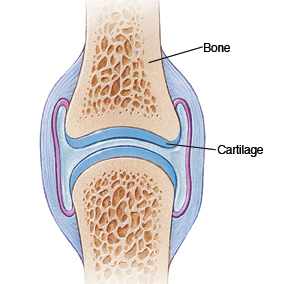
Arthralgia is the term for pain in or around the joint. It is a symptom, not a disease. This pain may affect one or more joints. In some cases, the pain moves from joint to joint.
There are many causes for joint pain. They include:
-
Injury.
-
Wearing out the joint surface (osteoarthritis).
-
Inflammation of the joint because of crystals in the joint fluid (gout).
-
Infection inside the joint.
-
Inflammation of the fluid-filled sacs around the joint (bursitis).
-
Autoimmune disorders, such as rheumatoid arthritis or lupus.
-
Inflammation of chords that attach muscle to bone (tendonitis).
Home care
-
Rest the affected joints until your symptoms improve.
-
Eat a healthy diet, exercise as advised by your health care provider, and stay at a healthy weight.
-
You may be prescribed pain medicine. If not, you may use acetaminophen or ibuprofen to control pain and inflammation. Check with your provider before using OTC pain medicines, especially if you have any kidney or liver problems, stomach ulcers, or are on blood thinners.
-
For non-arthritis joint pain, rest can help. So can warm baths, massage, and stretching exercises.
Follow-up care
Follow up with your provider as advised.
When to contact your doctor
Contact your provider right away if:
-
The pain, swelling, or redness of the joint increases.
-
The pain gets worse or comes back after some improvement.
-
The pain moves to other joints.
-
The affected joint can't bear your weight.
-
You can't move the affected joint.
-
The joint looks deformed.
-
A new rash appears.
-
You have a fever of 100.4ºF (38ºC) or higher, or as advised by your provider.
-
New symptoms appear.
Online Medical Reviewer: Diane Horowitz MD
Online Medical Reviewer: Marianne Fraser MSN RN
Online Medical Reviewer: Raymond Kent Turley BSN MSN RN
Date Last Reviewed: 04/01/2025
© 2000-2026 The StayWell Company, LLC. All rights reserved. This information is not intended as a substitute for professional medical care. Always follow your healthcare professional's instructions.
Need Help? We're Here for You
Our Member and Recipient Services Team is here to help you understand your benefits, find care, or resolve concerns.
800-510-9132
Call NC Quitline
Need support to quit smoking, vaping, or to quit other nicotine products? You can receive support including medicines free of charge:
800-784-8669
Schedule Transportation
Need transportation to a doctor's office, pharmacy, or other covered healthcare service? Contact us to arrange your ride.
800-510-9132
Provider Directory
Need to find a provider like a Primary Care Physician, Specialist, OB/GYN, or a Psychiatrist?
Provider DirectoryRelated Articles
Chronic Pain
Pain that lasts longer than 6 months is called chronic pain. This is pain that's present even after the body has healed. Read on to learn how to manage chronic pain at home.
Discharge Instructions: Internal Fixation of a Fractured Femur
Instructions to care for yourself after having internal fixation of a fractured femur.
Discharge Instructions: Caring for Your Plaster Cast
A cast helps your body heal by holding your injured bones or joints in place. Here is information on how to take care of your cast.
Discharge Instructions: Using a Walker to Sit Down and Stand Up
To use your walker, you need to learn new ways to get around. A walker can help you when you sit down and stand up.