When you take a step or raise your hand, your joints help you move freely. But living with a worn or injured joint can make an active lifestyle painful. Your doctor uses arthroscopy to see, diagnose, and often treat your joint problem. Other diagnostic tests are usually done before arthroscopy. They include a complete health history and exam. You also might get an X-ray, CT scan, or MRI. After arthroscopy, you may be able to return to many of the activities you once enjoyed.
Why arthroscopy?
-
The surgeon can often find and treat the problem during 1 procedure.
-
The surgeon can often see the joint better than with open surgery.
-
Arthroscopy uses smaller incisions than open surgery. So you may recover faster. You may have less scarring.
How arthroscopy works
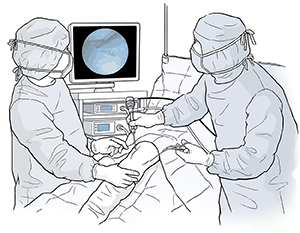
Your surgeon will use an arthroscope to look inside your joint. This is a thin instrument about the size of a pencil that contains a lens and a light source. Your doctor puts the arthroscope and other special tools into the joint through tiny cuts (incisions). The arthroscope uses a camera to send an image of your joint to a monitor. This lets your surgeon see your joint more clearly. You will still get anesthesia. It may be general, spinal, or local. This means that you will not feel the arthroscopy at all.
Risks of arthroscopy
As with any surgery, arthroscopy involves some risks. These are rare but include:
-
Excess bleeding.
-
Blood clots.
-
Infection.
-
Damage to nerves and blood vessels.
-
A shift to open surgery that would need a larger incision.
-
Reaction to the anesthesia.
Online Medical Reviewer: Raymond Turley Jr PA-C
Online Medical Reviewer: Stacey Wojcik MBA BSN RN
Online Medical Reviewer: Thomas N Joseph MD
Date Last Reviewed: 05/01/2025
© 2000-2026 The StayWell Company, LLC. All rights reserved. This information is not intended as a substitute for professional medical care. Always follow your healthcare professional's instructions.
Need Help? We're Here for You
Our Member and Recipient Services Team is here to help you understand your benefits, find care, or resolve concerns.
800-510-9132
Call NC Quitline
Need support to quit smoking, vaping, or to quit other nicotine products? You can receive support including medicines free of charge:
800-784-8669
Schedule Transportation
Need transportation to a doctor's office, pharmacy, or other covered healthcare service? Contact us to arrange your ride.
800-510-9132
Provider Directory
Need to find a provider like a Primary Care Physician, Specialist, OB/GYN, or a Psychiatrist?
Provider DirectoryRelated Articles
Foot Surgery: Plantar Fascia Problems
Your plantar fascia is the ligament that extends from the heel of your foot to the ball of your foot. If your foot flattens too much or too little as you move, you may strain your plantar fascia. While the vast majority of people with plantar fascia pain can be helped with nonsurgical treatments, surgery can be considered if these treatments fail.
Understanding Upper Arm Fracture Open Reduction and Internal Fixation (ORIF)
Open reduction and internal fixation (ORIF) is a type of treatment to fix a broken bone. It puts the pieces of a broken bone back together so they can heal.
First Aid: Sprains and Fractures
A sprain happens when ligaments, the fibrous tissues that connect bones at a joint, pull or tear. A fracture may happen when a bone is hit with more force than it can bear. Learn about first aid for a sprain or fracture.
Microdiskectomy
During a microdiscectomy, some disk is removed. In most cases, bone must first be removed to expose the damaged disk. The part of the disk outer wall and soft center that presses on the nerve can then be removed. There is usually enough disk remaining to cushion the vertebrae.