Movement is one of the best ways to treat back pain. Your healthcare provider may recommend exercises to help you manage your pain, speed healing, and prevent future flare-ups.
Talk to your healthcare provider or physical therapist about which exercises are best for you and your rehabilitation goals.
Start each exercise slowly. A little discomfort is normal but stop any exercise that causes pain.
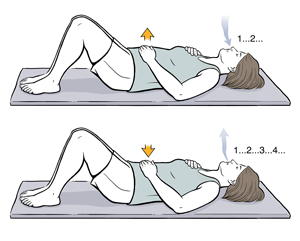
Belly Breathing
-
Lie on your back with your knees bent and feet flat on the floor. You can also perform this exercise while lying in bed with your knees supported by pillows.
-
Place one hand on your chest and one hand on your belly.
-
Breathe in slowly through your nose. Count to 2. As you breathe in, your belly should move out against your hand. Your chest should stay still.
-
Breathe out through your mouth with your lips pursed together. Count to 4. As you breathe out, you should feel your stomach move in.
-
Practice this breathing method for
2 minutes.
Tip:
-
Counting as you breathe in and out helps keep your breathing slow and steady.
Prone Lying
-
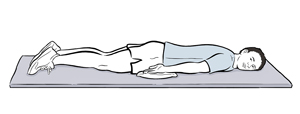
Lie face down on your stomach, either on the floor or in bed. You can place a pillow under your stomach and pelvis for comfort if needed.
-
Keep your arms relaxed at your side. Keep your breathing relaxed.
-
Continue to lie in this position for
3 to5 minutes.
Prone Press Up
-
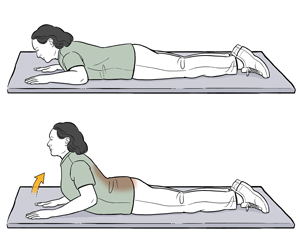
Lie face down on your stomach. Your elbows should be tucked into your sides.
-
Press up on your forearms, keeping your hips on the floor.
-
Hold for
5 to10 seconds. Then lower slowly. -
Repeat
5-8 times.
Tips:
-
Relax your stomach muscles and low back completely as you press up.
-
Stay within a pain-free range.
Walking
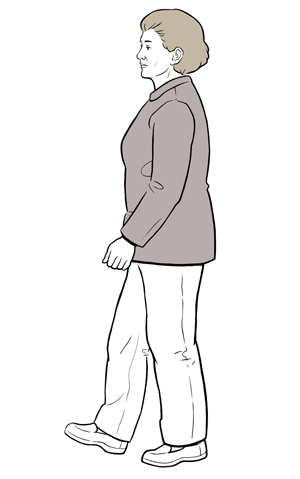
Walking is a great way to improve blood flow and ease pain. Even short walks can help. Make a habit of walking every day. If walking makes your pain worse, try walking in a pool to reduce the pressure on your back.
-
Start by walking for
10 minutes every day. -
Over time, work up to walking for
30 minutes or longer.
Date Last Reviewed: 12/01/2023
© 2000-2026 The StayWell Company, LLC. All rights reserved. This information is not intended as a substitute for professional medical care. Always follow your healthcare professional's instructions.
Need Help? We're Here for You
Our Member and Recipient Services Team is here to help you understand your benefits, find care, or resolve concerns.
800-510-9132
Call NC Quitline
Need support to quit smoking, vaping, or to quit other nicotine products? You can receive support including medicines free of charge:
800-784-8669
Schedule Transportation
Need transportation to a doctor's office, pharmacy, or other covered healthcare service? Contact us to arrange your ride.
800-510-9132
Provider Directory
Need to find a provider like a Primary Care Physician, Specialist, OB/GYN, or a Psychiatrist?
Provider DirectoryRelated Articles
Exercise Program for Hip Arthritis
Follow this exercise program to help decrease pain and improve function in your hips.
Exercise Program for Rotator Cuff Injury
Follow this exercise program to help treat your rotator cuff injury.
Exercise Program for IT Band Syndrome
Follow this exercise program to help treat your iliotibial (IT) band syndrome.
Exercise Program for Shoulder Dislocation
Follow this exercise program to help treat your shoulder dislocation.


