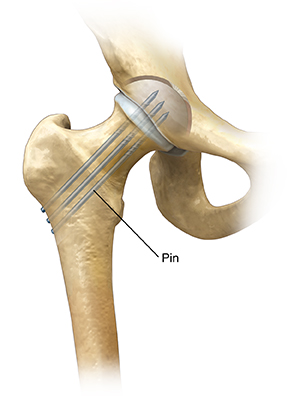
The type of surgery you have often depends on where the hip is fractured. In some cases, internal fixation is used. This is when pins, screws, or a rod is placed into the fractured bone to hold it in place as it heals. In other cases, part or all of the hip is replaced. This is done when there's a lack of blood supply to the head of the femur, or if internal fixation isn't advised.
Pins
Metal pins or large screws are sometimes used to repair fractures along the neck of the femur. The pins are inserted through the bone to keep it stable while it heals.
Screw and side plate
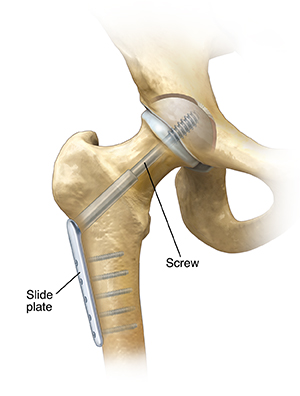
A metal compression screw and side plate may be used to repair the fracture. As the bone heals, the screw gets tighter. This allows the edges of the bone to grow together.
Rod
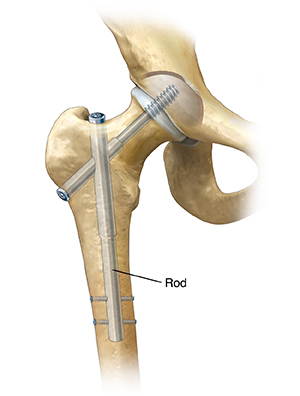
A metal rod or nail may be used if the fracture is along the upper shaft of the femur. The rod is inserted into the bone shaft. A screw keeps the bone edges together as they heal.
Hip replacement
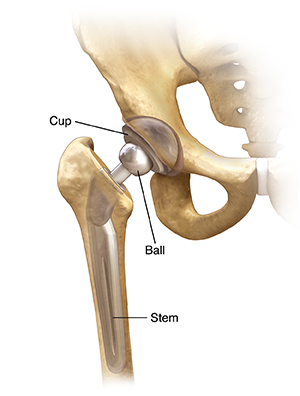
Artificial parts may be used to replace part or all of the hip joint. For a total hip replacement, a new stem and ball are placed in the femur. These fit into a new cup secured in the pelvis. For a partial hip replacement, only the stem and ball are replaced.
Featured in
Online Medical Reviewer: Image reviewed by StayWell medical illustration team.
Online Medical Reviewer: Joseph, Thomas N., MD
Online Medical Reviewer: Sather, Rita, RN
Date Last Reviewed: 04/01/2024
© 2000-2026 The StayWell Company, LLC. All rights reserved. This information is not intended as a substitute for professional medical care. Always follow your healthcare professional's instructions.
Need Help? We're Here for You
Our Member and Recipient Services Team is here to help you understand your benefits, find care, or resolve concerns.
800-510-9132
Call NC Quitline
Need support to quit smoking, vaping, or to quit other nicotine products? You can receive support including medicines free of charge:
800-784-8669
Schedule Transportation
Need transportation to a doctor's office, pharmacy, or other covered healthcare service? Contact us to arrange your ride.
800-510-9132
Provider Directory
Need to find a provider like a Primary Care Physician, Specialist, OB/GYN, or a Psychiatrist?
Provider DirectoryRelated Articles
Surgery for Shoulder Impingement
For many people, nonsurgical treatments are enough to ease shoulder impingement symptoms. But if these treatments haven’t worked, surgery may be an option.
Understanding Leg Amputation: Surgery for a Medical Condition
This surgery removes part or all your leg. It is done because tissue in the leg is diseased and can't be healed. Or it may be needed to prevent the disease from spreading farther into your body. The goal of the surgery is to restore your ability to function. This is because removing the diseased part of your leg can improve your total health.
Understanding Ankle Replacement Surgery
Ankle replacement surgery is a procedure to treat arthritis of the ankle joint. The damaged ankle joint is replaced with an artificial implant.
Preparing for Back Surgery
Plan ahead for both your surgery and recovery. Be sure to follow any instructions you are given. And talk to your doctor if you have questions about surgery or how the procedure will be done.